Intellectual cover is a usually negative term for sophisticated arguments provided by members of the intelligentsia to bolster a particular viewpoint, and thereby help it gain respectability. Usually the viewpoint is one that a supporter leaned toward anyway, but needed arguments to help him justify to others.More at Wikipedia
Related References
Feng, C.. (2005). The Death of the Concerned Intellectual?. PORTAL: Journal of Multidisciplinary International Studies
Show/hide publication abstract
“This paper offers a definition of the intellectual covering both professional & moral dimensions: an intellectual is a specialist who creates & communicates symbolised knowledge as means of living, & hopefully intervenes in social & political affairs in the name of universal values, truth & justice. ‘symbolised knowledge’ is used in the definition to avoid the confusion with other forms of knowledge derived from direct personal experience in production & life. the purpose of using ‘specialist’ as the subject term is to exclude those categories such politicians, soldiers & business people who exercise political, military, financial & other forms of power instead of intellectual power in their social function. this paper argues that there are many roles played by intellectuals, & the social location & function of intellectuals can be fundamentally different in different societies. when production & communication of knowledge are taken as the primary concern of intellectuals, ‘the death of the concerned intellectual’ becomes an unwarranted anxiety, because there is no reason to believe that knowledge & truth will no longer be pursued & valued by humankind. political marginalisation of critical intellectuals, where it is a reality, seems to be caused not so much by the lack of power of intellectuals as by the lack of solidarity among intellectuals to fight for a common cause. the problem lies as much in the lack of enthusiasm among intellectuals to transcend the boundaries of their professional relevance & intervene in broad social & political issues, as in institutional structures consuming too much energy & time of the intellectuals & seducing them to give up their social responsibilities for personal career. references. adapted from the source document.”
The quadrivium (plural: quadrivia) is the four subjects, or arts, taught after teaching the trivium. The word is Latin, meaning four ways, and its use for the four subjects has been attributed to Boethius or Cassiodorus in the 6th century. Together, the trivium and the quadrivium comprised the seven liberal arts (based on thinking skills), as distinguished from the practical arts (such as medicine and architecture).
Etymologically, the Latin word trivium means “the place where three roads meet” (tri + via); hence, the subjects of the trivium are the foundation for the quadrivium, the upper division of the medieval education in the liberal arts, which comprised arithmetic (number), geometry (number in space), music (number in time), and astronomy (number in space and time). Educationally, the trivium and the quadrivium imparted to the student the seven liberal arts of classical antiquity.[1]
Grammar teaches the mechanics of language to the student. This is the step where the student “comes to terms,” defining the objects and information perceived by the five senses. Hence, the Law of Identity: a tree is a tree, and not a cat.
Logic (also dialectic) is the “mechanics” of thought and of analysis, the process of identifying fallacious arguments and statements and so systematically removing contradictions, thereby producing factual knowledge that can be trusted.
Rhetoric is the application of language in order to instruct and to persuade the listener and the reader. It is the knowledge (grammar) now understood (logic) and being transmitted outwards as wisdom (rhetoric).
One can utilise a computer analogy to conceptually explain the Trivium. Per analogiam, input (via input channels such as the senses/sensors, or any other form of information transmission ) refers to grammar, processing to logic (thought & analysis), and output to rhetoric (written words & spoken language).
Sister Miriam Joseph, in The Trivium: The Liberal Arts of Logic, Grammar, and Rhetoric (2002), described the trivium as follows:
Grammar is the art of inventing symbols and combining them to express thought; logic is the art of thinking; and rhetoric is the art of communicating thought from one mind to another, the adaptation of language to circumstance.
. . .
Grammar is concerned with the thing as-it-is-symbolized. Logic is concerned with the thing as-it-is-known. Rhetoric is concerned with the thing as-it-is-communicated.[4]
John Ayto wrote in the Dictionary of Word Origins (1990) that study of the trivium (grammar, logic, and rhetoric) was requisite preparation for study of the quadrivium (arithmetic, geometry, music, and astronomy). For the medieval student, the trivium was the curricular beginning of the acquisition of the seven liberal arts; as such, it was the principal undergraduate course of study. The wordtrivial arose from the contrast between the simpler trivium and the more difficult quadrivium.[5]
Quadrivium
The quadrivium consisted of arithmetic, geometry, music, and astronomy. These followed the preparatory work of the trivium, consisting of grammar, logic, and rhetoric. In turn, the quadrivium was considered preparatory work for the study of philosophy (sometimes called the “liberal art par excellence”)[5] and theology.
These four studies compose the secondary part of the curriculum outlined by Plato in The Republic and are described in the seventh book of that work (in the order Arithmetic, Geometry, Astronomy, Music). [4] The quadrivium is implicit in early Pythagorean writings and in the De nuptiis of Martianus Capella, although the term quadrivium was not used until Boethius, early in the sixth century.[6] As Proclus wrote:
The Pythagoreans considered all mathematical science to be divided into four parts: one half they marked off as concerned with quantity, the other half with magnitude; and each of these they posited as twofold. A quantity can be considered in regard to its character by itself or in its relation to another quantity, magnitudes as either stationary or in motion. Arithmetic, then, studies quantities as such, music the relations between quantities, geometry magnitude at rest, spherics [astronomy] magnitude inherently moving.[7]
Medieval usage
At many medieval universities, this would have been the course leading to the degree of Master of Arts (after the BA). After the MA, the student could enter for bachelor’s degrees of the higher faculties (Theology, Medicine or Law). To this day, some of the postgraduate degree courses lead to the degree of Bachelor (the B.Phil and B.Litt. degrees are examples in the field of philosophy).
The study was eclectic, approaching the philosophical objectives sought by considering it from each aspect of the quadrivium within the general structure demonstrated by Proclus (AD 412–485), namely arithmetic and music on the one hand[8] and geometry and cosmology on the other.[9]
The subject of music within the quadrivium was originally the classical subject of harmonics, in particular the study of the proportions between the musical intervals created by the division of a monochord. A relationship to music as actually practised was not part of this study, but the framework of classical harmonics would substantially influence the content and structure of music theory as practised in both European and Islamic cultures.
Modern usage
In modern applications of the liberal arts as curriculum in colleges or universities, the quadrivium may be considered to be the study of number and its relationship to space or time: arithmetic was pure number, geometry was number in space, music was number in time, and astronomy was number in space and time. Morris Kline classified the four elements of the quadrivium as pure (arithmetic), stationary (geometry), moving (astronomy), and applied (music) number.[10]
“Today’s conflicts between the views that the humanities hold of science and engineering and the views science and engineering hold of the humanities weaken the very core of our culture. their cause is lack of integration in today’s education among subjects that hark back to the medieval trivium and quadrivium. a new trivium is needed to provide every educated person with a basic understanding of the endeavors and instruments that help us address our world and shape a new morality – the humanities, in the noblest sense of the word, to civilize, science to understand nature, and engineering, broadly defined, to encompass the kindred activities that modify nature. integration of these endeavors is urgent. it involves, in turn, an intimate interaction (the ‘biosoma’) of biological organisms, society, and machines – a new quadrivium. no domain can any longer be considered and learned in isolation.”
Etzkowitz, H., Ranga, M., & Dzisah, J.. (2012). Whither the university? The Novum Trivium and the transition from industrial to knowledge society. Social Science Information
“Beyond the bologna process key objective of achieving a common structure of the european tertiary educational format is the fundamental issue of the changing content of higher education. the highly specialized curricula of the industrial society no longer fully meet the needs of an emerging knowledge society that requires citizens with entrepreneurial and inter-cultural capabilities to innovate and respond to change in an increasingly inter-connected world. in this article we propose an innovative approach to undergraduate education called the novum trivium, comprised of (i) academic specialization, (ii) innovation and entrepreneurship, and (iii) a language and culture in addition to one’s own, as a new higher-education paradigm for the knowledge society. this vision of undergraduate education aims to contribute to the realization of the bologna process objective of better integrating education, research and innovation. the novum trivium brings together three diverse, yet complementary, educational skill sets, in a modern version of the tripos degree introduced by cambridge university in the 17th century as an honours degree in mathematics that eventually became a format that encompassed three closely related disciplines such as politics, philosophy and economics. the novum trivium is also inspired by the medieval trivium of grammar, rhetoric and dialectics (logic), the essential elements of education for all.”
The term habitus(/ˈhæbɪtəs/) refers to ingrained habits, skills, and psychological/behavioral dispositions. It is the way that individuals perceive the social world around them and react to it. These dispositions are usually shared by people with similar backgrounds (such as social class, religion, nationality, ethnicity, education, profession etc.). The habitus is acquired through imitation (mimesis) and is the reality that individuals are socialized, which includes their individual experience and opportunities. Thus, the habitus represents the way group culture and personal history shape the body and the mind, and as a result, shape present social actions of an individual.
Pierre Bourdieu suggested that the habitus consists of both the hexis (the tendency to hold and use one’s body in a certain way, such as posture and accent) and more abstract mental habits, schemes of perception, classification, appreciation, feeling, and action. These schemes are not mere habits: Bourdieu suggested they allow individuals to find new solutions to new situations without calculated deliberation, based on their gut feelings and intuitions, which Bourdieu believed were collective and socially shaped. These attitudes, mannerisms, tastes, moral intuitions and habits have influence on the individual’s life chances, so the habitus not only is structured by an individual’s objective past position in the social structure but also structures the individual’s future life path. Pierre Bourdieu argued that the reproduction of the social structure results from the habitus of individuals (Bourdieu, 1987).
References
Reay, D.. (2004). “It’s all becoming a habitus”: Beyond the habitual use of habitus in educational research. British Journal of Sociology of Education
“The concept of habitus lies at the heart of bourdieu’s theoretical framework. it is a complex concept that takes many shapes and forms in bourdieu’s own writing, even more so in the wider sociological work of other academics. in the ®rst part of this paper i develop an understanding of habitus, based on bourdieu’s many writings on the concept, that recognizes both its permeability and its ability to capture continuity and change. i also map its relationship to bourdieu’s other concepts, in particular ®eld and cultural capital. in the second part of the paper i examine attempts to operationalize habitus in empirical research in education. i critique the contemporary fashion of overlaying research analyses with bourdieu’s concepts, including habitus, rather than making the concepts work in the context of the data and the research settings. in the ®nal part of the paper i draw on a range of research examples that utilize habitus as a research tool to illustrate how habitus can be made to work in educational research.”
Lyons, A. P., Bourdieu, P., & Nice, R.. (1980). Outline of a Theory of Practice. ASA Review of Books
“Outline of a theory of practice is recognized as a major theoretical text on the foundations of anthropology and sociology. pierre bourdieu, a distinguished french anthropologist, develops a theory of practice which is simultaneously a critique of the methods and postures of social science and a general account of how human action should be understood. with his central concept of the habitus, the principle which negotiates between objective structures and practices, bourdieu is able to transcend the dichotomies which have shaped theoretical thinking about the social world. the author draws on his fieldwork in kabylia (algeria) to illustrate his theoretical propositions. with detailed study of matrimonial strategies and the role of rite and myth, he analyses the dialectical process of the ‘incorporation of structures’ and the objectification of habitus, whereby social formations tend to reproduce themselves. a rigorous consistent materialist approach lays the foundations for a theory of symbolic capital and, through analysis of the different modes of domination, a theory of symbolic power.”
Bourdieu, P.. (1969). Structures, Habitus, Practices. In The Logic of Practice
“This paper aims to balance the conceptual reception of bourdieu’s sociology in the united states through a conceptual re-examination of the concept of habitus. i retrace the intellectual lineage of the habitus idea, showing it to have roots in claude levi-strauss structural anthropology and in the developmental psychology of jean piaget, especially the latter’s generalization of the idea of operations from mathematics to the study of practical, bodily-mediated cognition. one important payoff of this exercise is that the common misinterpretation of the habitus as an objectivist and reductionist element in bourdieu’s thought is dispelled. the habitus is shown to be instead a useful and flexible way to conceptualize agency and the ability to transform social structure. thus ultimately one of bourdieu’s major contributions to social theory consists of his development of a new radical form of cognitive sociology, along with an innovative variety of multilevel sociological explanation in which the interplay of different structural orders is highlighted.”
Jason D. Edgerton, & Roberts, L. W.. (2014). Habitus. In Encyclopedia of Quality of Life and Well-Being Research
“Definition the relationship (correlation) between separate scales or subscales. description the value between +1 and −1 that represents the correlation between two scales is the interscale correlation. in quality of life literature, interscale correlations are used frequently (aaronson et al., 1993; borghede & sullivan, 1996; fekkes et al., 2000; hearn & higginson, 1997). a researcher may choose to determine the interscale correlation in situations in which she/he has multiple scales and wants to investigate the relationship between the variables that those scales are measuring. depending on the nature of the research, a high or low interscale correlation could be sought after. in the case of a validity study, a researcher may want to examine how similar a newly created scale is to another scale that is deemed to be a ‘gold standard.’ finding that the researcher’s scale has a high correlation with the other scale would lend itself to evidence of”
Wacquant, L.. (2007). Esclarecer o Habitus. Educação & Linguagem
“Tomando como referência a obra do sociólogo pierre bourdieu, o presente artigo traz uma reconstituição da gênese da noção de habitus presente nos trabalhos do autor e, em uma perspectiva de síntese, procura documentar algumas de suas principais propriedades teóricas. traça, igualmente, um pequeno retrato dos principais horizontes de mobilização sociológica de que a noção tem sido alvo, destacando que a noção de habitus, para bourdieu, é um modo estenográfico de designar uma postura de investigação adequada à observação metódica da constituição social de agentes em quadros institucionais diversos.”
Crossley, N.. (2013). Habit and Habitus. Body and Society
“This article compares the concept of habitus, as formulated in the work of mauss and bourdieu, with the concept of habit, as formulated in the work of merleau-ponty and dewey. the rationale for this, on one level, is to seek to clarify these concepts and any distinction that there may be between them – though the article notes the wide variety of uses of both concepts and suggests that these negate the possibility of any definitive definitions or contrasts. more centrally, however, the purpose of the comparison is to draw out a number of important issues and debates which, it is argued, further work must address if the concepts of habit and habitus are to continue to prove useful and illuminating in social science.”
Silva, E. B.. (2016). Habitus: Beyond sociology. Sociological Review
“This paper presents a contribution of a set of interrelated innovative thinking to revitalize the sociological understanding of the notion of the habitus. it discusses contributions by sociologists exploring the sources of bourdieu’s inspiration from psychology and psychoanalysis to the development of the concept, and brings in new thinking inspired by authors and frameworks that branch out of sociology to bring into sociology fresher thinking. three areas of concern about habitus are focused on: firstly, the objectivism and subjectivism dichotomy; secondly, the plasticity or rigidity of the concept; and thirdly, the implications of intangibles attached to the notion. the paper introduces a special section including five articles on theoretical and empirical explorations bringing exciting perspectives to creative and critical sociology.”
Gaddis, S. M.. (2013). The influence of habitus in the relationship between cultural capital and academic achievement. Social Science Research
“This paper examines some of the issues surrounding student retention in higher education. it is based on the case study of a modern university in england that has good performance indicators of both widening participation (i.e. increasing the diversity of the student intake) and student retention. the two-fold nature of this success is significant, as it has been asserted that greater diversity will necessarily lead to an increase in student withdrawal. furthermore, changes to student funding in the uk put greater financial pressures and stress on students, especially those from low-income groups. nevertheless, many students cope with poverty, high levels of debt and significant burdens of paid work to successfully complete their courses of study. drawing on the work of r eay et al. (2001), this paper adopts and explores the terinstitutional habitus’, and attempts to provide a conceptual and empirical understand-ing of the ways in which the values and practices of a higher education institution impact on student retention.”
Mutch, A.. (2003). Communities of practice and habitus: A critique. Organization Studies
“Outline of a theory of practice is recognized as a major theoretical text on the foundations of anthropology and sociology. pierre bourdieu, a distinguished french anthropologist, develops a theory of practice which is simultaneously a critique of the methods and postures of social science and a general account of how human action should be understood. with his central concept of the habitus, the principle which negotiates between objective structures and practices, bourdieu is able to transcend the dichotomies which have shaped theoretical thinking about the social world. the author draws on his fieldwork in kabylia (algeria) to illustrate his theoretical propositions. with detailed study of matrimonial strategies and the role of rite and myth, he analyses the dialectical process of the ‘incorporation of structures’ and the objectification of habitus, whereby social formations tend to reproduce themselves. a rigorous consistent materialist approach lays the foundations for a theory of symbolic capital and, through analysis of the different modes of domination, a theory of symbolic power.”
Bourdieu, P.. (1986). Habitus, code et codification. Actes de La Recherche En Sciences Sociales
“S’il est de la vocation même de la sociologie de rappeler que, selon le mot de montesquieu, on ne transforme pas la société par décret, il reste que la conscience des conditions sociales de l’efficacité des actes juridiques ne doit pas conduire à ignorer ou à nier ce qui fait l’efficacité propre de la règle, du règlement et de la loi. la juste réaction contre le juridisme, qui conduit à restituer leur place, dans l’explication des pratiques, aux dispositions constitutives de l’habitus, n’implique nullement que l’on mette entre parenthèses l’effet propre de la règle explicitement énoncée, surtout lorsque, comme la règle juridique, elle est associée à des sanctions. et inversement, s’il n’est pas douteux que le droit exerce une efficacité spécifique, imputable notamment au travail de codification, de mise en forme et en formule, de neutralisation et de systématisation, que réalisent, selon les lois propres de leur univers, les professionnels du travail symbolique, il reste que cette efficacité, qui se définit par opposition à l’inapplication pure et simple ou à l’application fondée sur la contrainte pure, s’exerce dans la mesure et dans la mesure seulement où le droit est socialement reconnu, et rencontre un accord, même tacite et partiel, parce qu’il répond, au moins en apparence, à des besoins et des intérêts réels.”
Hanks, W. F.. (2005). PIERRE BOURDIEU AND THE PRACTICES OF LANGUAGE. Annual Review of Anthropology
“This paper synthesizes research on linguistic practice and critically examines the legacy of pierre bourdieu from the perspective of linguistic anthropology. bourdieu wrote widely about language and linguistics, but his most far reaching engagement with the topic is in his use of linguistic reasoning to elaborate broader sociological concepts including habitus, field, standardization, legitimacy, censorship, and symbolic power. the paper examines and relates habitus and field in detail, tracing the former to the work of erwin panofsky and the latter to structuralist discourse semantics. the principles of relative autonomy, boundedness, homology, and embedding apply to fields and their linkage to habitus. authority, censorship, and euphemism are traced to the field, and symbolic power is related to misrecognition. and last, this chapter relates recent work in linguistic anthropology to practice and indicates lines for future research.”
Bourdieu, P.. (2000). Making the Economic Habitus: Algerian Workers Revisited. Ethnography
“During the war of national liberation algeria offered a quasi-laboratory situation for analysing the mismatch between the economic dispositions fashioned in a precapitalist economy, embedded in relations of group honour, and the rationalized economic cosmos imposed by colonization. ethnographic observation of this mismatch revealed that, far from being axiomatic, the most elementary economic behaviours (working for a wage, saving, credit, birth control, etc.) have definite economic and social conditions of possibility which both economic theory and the `new economic sociology’ ignore. acquiring the spirit of calculation required by the modern economy entails a veritable conversion via the apostasy of the embodied beliefs that underpin exchange in traditional kabyle society. the `folk economics’ of a cook from algiers allows us to grasp the practical economic sense guiding the emerging algerian working class at the dawn of the country’s independence.”
King, A.. (2000). Thinking with Bourdieu against Bourdieu: A “practical” critique of the habitus. Sociological Theory
“There are two strands in bourdieu’s sociological writings. on the one hand, bourdieu argues for a theoretical position one might term his ‘practical theory’ which emphasizes virtuosic interactions between individuals. on the other hand, and most frequently, bourdieu appeals to the concept of the habitus according to which society consists of objective structures and determined-and isolated-individuals. although bourdieu believes that the habitus is compatible with his practical theory and overcomes the impasse of objectivism and subjectivism in social theory, neither claim is the case; the habitus is incompatible with his practical theory, and it retreats quickly into objectivism. however, bourdieu’s practical theory does offer a way out of the impasse of objectivism and subjectivism by focussing on the intersubjective interactions between individuals.”
Crossley, N.. (2001). The phenomenological habitus and its construction. Theory and Society
“This article focuses on the phenomenological habitus and its construction. the concepts ‘habit’ and ‘habitus,’ having almost disappeared from the sociological lexicon during the earlier part of the post-war period, are currently enjoying renewed interest in the social sciences. this is due, in large part, to the work of the sociologist pierre bourdieu. his work draws out the significance and relevance of the concept of habit for sociological purposes and in doing so makes a very appealing case for a habit or disposition based theory of agency. this is not intended as a phenomenological critique of bourdieu, a call to replace his conception of habit with a phenomenological one nor a call for a full scale ‘marriage’ of phenomenology with bourdieu’s sociology. bourdieu formulates his concept of the habitus in the context of a critical engagement with structuralism and ‘social physics,’ on the one hand, and ‘social phenomenology’ on the other. against social physics and structuralism, he argues for a notion of competent and active agency.”
Sewell, W. H.. (1992). A Theory of Structure: Duality, Agency, and Transformation. American Journal of Sociology
“‘Structure’ is one of the most important, elusive, and undertheo- rized concepts in the social sciences. setting out from a critique and reformulation of anthony giddens’s notion of the duality of structure and pierre bourdieu’s notion of habitus, this article at- tempts to develop a theory of structure that restores human agency to social actors, builds the possibility of change into the concept of structure, and overcomes the divide between semiotic and material- ist visions of structure. ‘structure’”
Nash, R.. (1990). Bourdieu on Education and Social and Cultural Reproduction. British Journal of Sociology of Education
“Bourdieu’s work has attracted considerable interest and, not withstanding criticism of his style and obscure theoretical formulations, has introduced some powerful concepts into social theory. this paper examines bourdieu’s contribution to the sociology of education and especially his account of socially differentiated educational attainment. particular attention is given to issues of structure, agency and habitus, the cultural autonomy of the school, arbitrary and necessary school cultures, and the distinction between primary and secondary effects on educational differences. some specific criticisms, for example elster’s charge of a double account of domination, are also addressed. bourdieu’s concentration on habitus as the most significant generator of practice is held to be a theory of socialisation and the paper examines the nature of the explanation of social practice provided by such theories. the argument concludes with a plea for critical tolerance with respect to bourdieu’s work but with a suggestion that his account of socially differentiated educational attainment in terms of habitus is finally inadequate.”
Asch, S. E.. (1956). Studies of independence and conformity: I. A minority of one against a unanimous majority.. Psychological Monographs: General and Applied
“The investigations described in this series are concerned with the conditions of independence and lack of independence in the face of group pressure. the abstract temper of present-day theory and investigation in this region rests to a considerable degree on a neglect of the cognitive and emotional experiences that are part of the individual’s psychological field. the understanding of social influences will require the study of a wide range of conditions and of the interrelated operations of different psychological functions. a group of seven to nine individuals was gathered in a classroom to take part in what appeared to be a simple experiment in visual discrimination. the subjects were all male, white college students, ranging in age from 17 to 25; the mean age was 20. for certain purposes a large number of critical subjects was required for the present experiment. the present report is based on a total of 123 subjects. the task consisted of the comparison of a standard line with three other lines, one of which was equal in length to the standard. we investigated some of the conditions responsible for independence and lack of independence in the face of arbitrary group pressure. to this end we produced a disagreement between a group and one individual member about a clear and simple issue of fact. the interview, which followed the experimental session, provided qualitative evidence concerning the effects produced by the majority, the particular properties of the experimental situation and their relation to more usual social contradictions were described. (psycinfo database record (c) 2012 apa, all rights reserved)”
Baron, R. S., Vandello, J. A., & Brunsman, B.. (1996). The Forgotten Variable in Conformity Research: Impact of Task Importance on Social Influence. Journal of Personality and Social Psychology
“Two studies examined how incentives for accuracy (task importance) affected the social influence of inaccurate confederates in a modified asch situation (s. e. asch, 1951). not unexpectedly, when task difficulty was low, incentives for accuracy reduced the social impact of (inaccurate) confederates (study 1). however, when task difficulty was increased, the reverse was true, with individuals conforming more to an inaccurate confederate norm when incentives for accuracy were high (studies 1 and 2). the results are discussed in terms of possible mediating mechanisms and also in terms of their historical and pragmatic implications.”
Kundu, P., & Cummins, D. D.. (2013). Morality and conformity: The Asch paradigm applied to moral decisions. Social Influence
“Morality has long been considered an inherent quality, an internal moral compass that is unswayed by the actions of those around us. the solomon asch paradigm was employed to gauge whether moral decision making is subject to conformity under social pressure as other types of decision making have been shown to be. participants made decisions about moral dilemmas either alone or in a group of confederates posing as peers. on a majority of trials confederates rendered decisions that were contrary to judgments typically elicited by the dilemmas. the results showed a pronounced effect of conformity: compared to the control condition, permissible actions were deemed less permissible when confederates found them objectionable, and impermissible actions were judged more permissible if confederates judged them so.”
Walker, M. B., & Andrade, M. G.. (1996). Conformity in the asch task as a function of age. Journal of Social Psychology
“The social conformity paradigm of asch (1956) was replicated to investigate the relationship between age and conformist behavior. one hundred ten australian school children and adolescents between 3 and 17 years of age participated in the study. each participant was placed in the position of being a minority of 1 against a wrong but unanimous majority of 3. the results indicate that conformity decreases with age in perceptually unambiguous tasks. conflicting evidence from earlier studies can be attributed to task ambiguity in those studies.”
Cinnirella, M., & Green, B.. (2007). Does “cyber-conformity” vary cross-culturally? Exploring the effect of culture and communication medium on social conformity. Computers in Human Behavior
“The article focuses on a study in which the effect of centrality in social networks is determined. it states that in a social network centrality has effect on a conformity named asch-type conformity. it mentions that respect social network data and friendship affinity data was collected for two different groups of actors. it informs that central actors are not interested in conforming whereas peripheral actors willing to conform which was expected in asch-type conformity.”
Gerard, H. B., Wilhelmy, R. A., & Conolley, E. S.. (1968). Conformity and group size.. Journal of Personality and Social Psychology
“Asch (1951) found a curvilinear relationship between majority size and conformity such that conformity increased with increases in group size up to a majority of 3 and then leveled off. it was hypothesized here that this effect was due to a perceived contingency of the choices of the others and that if perceived contingency were eliminated, conformity would be a linear function of group size. the procedure in 1 treatment was designed to induce perceived contingency in the others’ choices, that is, that they were following the leader, whereas in the other treatment an attempt was made to induce the perception that the others were responding independently of one another. the data indicate a linear trend under both perceived contingency and perceived independence.”
Rosenberg, L.. (1961). Group size, prior experience, and conformity. Journal of Abnormal and Social Psychology
“An effort was made to validate the findings of 2 previous workers regarding the effect of the size of a group (asch, 1952) and prior experience (mausner, 1953, 1954, 1957) upon conformity in the judgment of the length of lines. the results of asch and mausner were reproduced; there is a curvilinear relationship between size of a group (from 2 to 5) and influence on s to conform to what he believes are the estimates of the lines made by others. prior experience in making judgments of the lines was also found to influence the accuracy of judgment. (psycinfo database record (c) 2012 apa, all rights reserved)”
Neural top–down control of physiology concerns the direct regulation by the brain of emotional and physiological functions. Cellular functions include the immune system’s production of T-lymphocytes and antibodies, and nonimmune related homeostatic functions such as liver gluconeogenesis, sodium reabsorption, osmoregulation, and brown adipose tissue nonshivering thermogenesis.More at Wikipedia
Chiesa, A., Serretti, A., & Jakobsen, J. C.. (2013). Mindfulness: Top-down or bottom-up emotion regulation strategy?. Clinical Psychology Review
McRae, K., Misra, S., Prasad, A. K., Pereira, S. C., & Gross, J. J.. (2012). Bottom-up and top-down emotion generation: Implications for emotion regulation. Social Cognitive and Affective Neuroscience
“Emotion regulation plays a crucial role in adaptive functioning and mounting evidence suggests that some emotion regulation strategies are often more effective than others. however, little attention has been paid to the different ways emotions can be generated: from the ‘bottom-up’ (in response to inherently emotional perceptual properties of the stimulus) or ‘top-down’ (in response to cognitive evaluations). based on a process priming principle, we hypothesized that mode of emotion generation would interact with subsequent emotion regulation. specifically, we predicted that top-down emotions would be more successfully regulated by a top-down regulation strategy than bottom-up emotions. to test this hypothesis, we induced bottom-up and top-down emotions, and asked participants to decrease the negative impact of these emotions using cognitive reappraisal. we observed the predicted interaction between generation and regulation in two measures of emotional responding. as measured by self-reported affect, cognitive reappraisal was more successful on top-down generated emotions than bottom-up generated emotions. neurally, reappraisal of bottom-up generated emotions resulted in a paradoxical increase of amygdala activity. this interaction between mode of emotion generation and subsequent regulation should be taken into account when comparing of the efficacy of different types of emotion regulation, as well as when reappraisal is used to treat different types of clinical disorders.”
Terhune, D. B., Cleeremans, A., Raz, A., & Lynn, S. J.. (2017). Hypnosis and top-down regulation of consciousness. Neuroscience and Biobehavioral Reviews
“Hypnosis is a unique form of top-down regulation in which verbal suggestions are capable of eliciting pronounced changes in a multitude of psychological phenomena. hypnotic suggestion has been widely used both as a technique for studying basic science questions regarding human consciousness but also as a method for targeting a range of symptoms within a therapeutic context. here we provide a synthesis of current knowledge regarding the characteristics and neurocognitive mechanisms of hypnosis. we review evidence from cognitive neuroscience, experimental psychopathology, and clinical psychology regarding the utility of hypnosis as an experimental method for modulating consciousness, as a model for studying healthy and pathological cognition, and as a therapeutic vehicle. we also highlight the relations between hypnosis and other psychological phenomena, including the broader domain of suggestion and suggestibility, and conclude by identifying the most salient challenges confronting the nascent cognitive neuroscience of hypnosis and outlining future directions for research on hypnosis and suggestion.”
Zelazo, P. D., & Carlson, S. M.. (2012). Hot and Cool Executive Function in Childhood and Adolescence: Development and Plasticity. Child Development Perspectives
“Executive function (ef), which refers to the more deliberate, top-down neurocognitive processes involved in self-regulation, develops most rapidly during the preschool years, together with the growth of neural networks involving prefrontal cortex but continues to develop well into adulthood. both ef and the neural systems supporting ef vary as a function of motivational significance, and this article discusses the distinction between the top-down processes that operate in motivationally and emotionally significant situations (‘hot ef’) and the top-down processes that operate is more affectively neutral contexts (‘cool ef’). emerging evidence indicates that both hot and cool ef are surprisingly malleable, with implications for intervention and prevention.”
Johnstone, T., van Reekum, C. M., Urry, H. L., Kalin, N. H., & Davidson, R. J.. (2007). Failure to Regulate: Counterproductive Recruitment of Top-Down Prefrontal-Subcortical Circuitry in Major Depression. Journal of Neuroscience
“Although depressed mood is a normal occurrence in response to adversity in all individuals, what distinguishes those who are vulnerable to major depressive disorder (mdd) is their inability to effectively regulate negative mood when it arises. investigating the neural underpinnings of adaptive emotion regulation and the extent to which such processes are compromised in mdd may be helpful in understanding the pathophysiology of depression. we report results from a functional magnetic resonance imaging study demonstrating left-lateralized activation in the prefrontal cortex (pfc) when downregulating negative affect in nondepressed individuals, whereas depressed individuals showed bilateral pfc activation. furthermore, during an effortful affective reappraisal task, nondepressed individuals showed an inverse relationship between activation in left ventrolateral pfc and the amygdala that is mediated by the ventromedial pfc (vmpfc). no such relationship was found for depressed individuals, who instead show a positive association between vmpfc and amygdala. pupil dilation data suggest that those depressed patients who expend more effort to reappraise negative stimuli are characterized by accentuated activation in the amygdala, insula, and thalamus, whereas nondepressed individuals exhibit the opposite pattern. these findings indicate that a key feature underlying the pathophysiology of major depression is the counterproductive engagement of right prefrontal cortex and the lack of engagement of left lateral-ventromedial prefrontal circuitry important for the downregulation of amygdala responses to negative stimuli.”
Heatherton, T. F., & Wagner, D. D.. (2011). Cognitive neuroscience of self-regulation failure. Trends in Cognitive Sciences
Holzman, J. B., & Bridgett, D. J.. (2017). Heart rate variability indices as bio-markers of top-downself-regulatory mechanisms: A meta-analytic review. Neuroscience and Biobehavioral Reviews
“Theoretical perspectives posit that heart-rate variability (hrv) reflects self-regulatory capacity and therefore can be employed as a bio-marker of top-downself-regulation (the ability to regulate behavioral, cognitive, and emotional processes). however, existing findings of relations between self-regulation and hrv indices are mixed. to clarify the nature of such relations, we conducted a meta-analysis of 123 studies (n = 14,347) reporting relations between hrv indices and aspects of top-downself-regulation (e.g., executive functioning, emotion regulation, effortful control). a significant, albeit small, effect was observed (r = 0.09) such that greater hrv was related to better top-downself-regulation. differences in relations were negligible across aspects of self-regulation, self-regulation measurement methods, hrv computational techniques, at-risk compared with healthy samples, and the context of hrv measurement. stronger relations were observed in older relative to younger samples and in published compared to unpublished studies. these findings generally support the notion that hrv indices can tentatively be employed as bio-markers of top-downself-regulation. conceptual and theoretical implications, and critical gaps in current knowledge to be addressed by future work, are discussed.”
Kerr, C. E., Sacchet, M. D., Lazar, S. W., Moore, C. I., & Jones, S. R.. (2013). Mindfulness starts with the body: somatosensory attention and top-down modulation of cortical alpha rhythms in mindfulness meditation. Frontiers in Human Neuroscience
“Using a common set of mindfulness exercises, mindfulness based stress reduction (mbsr) and mindfulness based cognitive therapy (mbct) have been shown to reduce distress in chronic pain and decrease risk of depression relapse. these standardized mindfulness (st-mindfulness) practices predominantly require attending to breath and body sensations. here, we offer a novel view of st-mindfulness’s somatic focus as a form of training for optimizing attentional modulation of 7-14 hz alpha rhythms that play a key role in filtering inputs to primary sensory neocortex and organizing the flow of sensory information in the brain. in support of the framework, we describe our previous finding that st-mindfulness enhanced attentional regulation of alpha in primary somatosensory cortex (si). the framework allows us to make several predictions. in chronic pain, we predict somatic attention in st-mindfulness ‘de-biases’ alpha in si, freeing up pain-focused attentional resources. in depression relapse, we predict st-mindfulness’s somatic attention competes with internally focused rumination, as internally focused cognitive processes (including working memory) rely on alpha filtering of sensory input. our computational model predicts st-mindfulness enhances top-down modulation of alpha by facilitating precise alterations in timing and efficacy of si thalamocortical inputs. we conclude by considering how the framework aligns with buddhist teachings that mindfulness starts with ‘mindfulness of the body.’ translating this theory into neurophysiology, we hypothesize that with its somatic focus, mindfulness’ top-down alpha rhythm modulation in si enhances gain control which, in turn, sensitizes practitioners to better detect and regulate when the mind wanders from its somatic focus. this enhanced regulation of somatic mind-wandering may be an important early stage of mindfulness training that leads to enhanced cognitive regulation and metacognition.”
Wagner, D. D., Altman, M., Boswell, R. G., Kelley, W. M., & Heatherton, T. F.. (2013). Self-Regulatory Depletion Enhances Neural Responses to Rewards and Impairs Top-Down Control. Psychological Science
“To be successful at self-regulation, individuals must be able to resist impulses and desires. the strength model of self-regulation suggests that when self-regulatory capacity is depleted, self-control deficits result from a failure to engage top-down control mechanisms. using functional neuroimaging, we examined changes in brain activity in response to viewing desirable foods among 31 chronic dieters, half of whom completed a task known to result in self-regulatory depletion. compared with nondepleted dieters, depleted dieters exhibited greater food-cue-related activity in the orbitofrontal cortex, a brain area associated with coding the reward value and liking aspects of desirable foods; they also showed decreased functional connectivity between this area and the inferior frontal gyrus, a region commonly implicated in self-control. these findings suggest that self-regulatory depletion provokes self-control failure by reducing connectivity between brain regions that are involved in cognitive control and those that represent rewards, thereby decreasing the capacity to resist temptations.”
Phillips, A. G., Vacca, G., & Ahn, S.. (2008). A top-down perspective on dopamine, motivation and memory. Pharmacology Biochemistry and Behavior
“A train of action potentials (a spike train) can carry information in both the average firing rate and the pattern of spikes in the train. but can such a spike-pattern code be supported by cortical circuits? neurons in vitro produce a spike pattern in response to the injection of a fluctuating current. however, corticalneurons in vivo are modulated by local oscillatory neuronal activity and by top-down inputs. in a cortical circuit, precise spike patterns thus reflect the interaction between internally generated activity and sensory information encoded by input spike trains. we review the evidence for precise and reliable spike timing in the cortex and discuss its computational role.”
Self-control, an aspect of inhibitory control, is the ability to regulate one’s emotions, thoughts, and behavior in the face of temptations and impulses. As an executive function, self-control is a cognitive process that is necessary for regulating one’s behavior in order to achieve specific goals.More at Wikipedia
Baumeister, R. F., Vohs, K. D., & Tice, D. M.. (2007). The strength model of self-control. Current Directions in Psychological Science
“Self-control is a central function of the self and an important key to success in life. the exertion of self-control appears to depend on a limited resource. just as a muscle gets tired from exertion, acts of self-control cause short-termimpairments (ego depletion) in subsequent self-control, even on unrelated tasks. research has supported the strength model in the domains of eating, drinking, spending, sexuality, intelligent thought, making choices, and interpersonal behavior. motivational or framing factors can temporarily block the deleterious effects of being in a state of ego depletion. blood glucose is an important component of the energy.”
Ajzen, I.. (2002). Perceived behavioral control, self-efficacy, locus of control, and the theory of planned behavior. Journal of Applied Social Psychology
“Responses of neurons in inferior temporal cortex during memory-guided visual search. j. neurophysiol. 80: 2918-2940, 1998. a typical scene will contain many different objects, few of which are relevant to behavior at any given moment. thus attentional mechanisms are needed to select relevant objects for visual processing and control over behavior. we examined this role of attention in the inferior temporal cortex of macaque monkeys, using a visual search paradigm. while the monkey maintained fixation, a cue stimulus was presented at the center of gaze, followed by a blank delay period. after the delay, an array of two to five choice stimuli was presented extrafoveally, and the monkey was rewarded for detecting a target stimulus matching the cue. the behavioral response was a saccadic eye movement to the target in one version of the task and a lever release in another. the array was composed of one ‘good’ stimulus (effective in driving the cell when presented alone) and one or more ‘poor’ stimuli (ineffective in driving the cell when presented alone). most cells showed higher delay activity after a good stimulus used as the cue than after a poor stimulus. the baseline activity of cells was also higher preceding a good cue, if the animal expected it to occur. this activity may depend on a top-down bias in favor of cells coding the relevant stimulus. when the choice array was presented, most cells showed suppressive interactions between the stimuli as well as strong attention effects. when the choice array was presented in the contralateral visual field, most cells initially responded the same, regardless of which stimulus was the target. however, within 150-200 ms of array onset, responses were determined by the target stimulus. if the target was the good stimulus, the response to the array became equal to the response to the good stimulus presented alone. if the target was a poor stimulus, the response approached the response to that stimulus presented alone. thus the influence of the nontarget stimulus was eliminated. these effects occurred well in advance of the behavioral response. when the array was positioned with stimuli on opposite sides of the vertical meridian, the contralateral stimulus appeared to dominate the response, and this dominant effect could not be overcome by attention. overall, the results support a ‘biased competition’ model of attention, according to which 1) objects in the visual field compete for representation in the cortex, an…”
Muraven, M.. (2010). Building self-control strength: Practicing self-control leads to improved self-control performance. Journal of Experimental Social Psychology
“Self-control performance may be improved by the regular practice of small acts of self-control. ninety-two adults’ self-control capacity was assessed using the stop signal paradigm before they started practicing self-control and again at the end of 2 weeks. participants who practiced self-control by cutting back on sweets or squeezing a handgrip exhibited significant improvement in stop signal performance relative to those who practiced tasks that did not require self-control. participants who did not practice self-control believed that the tasks should improved self-control, engaged in tasks that were effortful and made self-control salient, but did not actually require self-control. supplemental analyses suggested that only practicing self-control built self-control capacity; the improved outcomes cannot be explained by self-fulfilling prophecies, increased self-efficacy or awareness of self-control. the results may have implications for understanding the development of self-control in both children and adults, as well as clinical implications for treating disorders that involve low self-control. ?? 2009 elsevier inc. all rights reserved.”
Muraven, M., Shmueli, D., & Burkley, E.. (2006). Conserving self-control strength. Journal of Personality and Social Psychology
“Individuals may be motivated to limit their use of self-control resources, especially when they have depleted some of that resource. expecting to need self-control strength in the future should heighten the motivation to conserve strength. in 4 experiments, it was found that depleted participants who anticipated exerting self-control in the future performed more poorly in an intervening test of self-control than participants who were not depleted, and more poorly than those who did not expect to exert self-control in the future. conversely, those who conserved strength performed better on tasks that they conserved the strength for as compared with those who did not conserve. the underlying economic or conservation of resource model sheds some light on the operation of self-control strength.”
Muraven, M., & Baumeister, R. F.. (2000). Self-Regulation and Depletion of Limited Resources: Does Self-Control Resemble a Muscle?. Psychological Bulletin
“The authors review evidence that self-control may consume a limited resource. exerting self-control may consume self-control strength, reducing the amount of strength available for subsequent self-control efforts. coping with stress, regulating negative affect, and resisting temptations require self-control, and after such self-control efforts, subsequent attempts at self-control are more likely to fail. continuous self-control efforts, such as vigilance, also degrade over time. these decrements in self-control are probably not due to negative moods or learned helplessness produced by the initial self-control attempt. these decrements appear to be specific to behaviors that involve self-control; behaviors that do not require self-control neither consume nor require self-control strength. it is concluded that the executive component of the self–in particular, inhibition–relies on a limited, consumable resource.”
McCullough, M. E., & Willoughby, B. L. B.. (2009). Religion, self-regulation, and self-control: Associations, explanations, and implications.. Psychological Bulletin
“Many of the links of religiousness with health, well-being, and social behavior may be due to religion’s influences on self-control or self-regulation. using carver and scheier’s (1998) theory of self-regulation as a framework for organizing the empirical research, the authors review evidence relevant to 6 propositions: (a) that religion can promote self-control; (b) that religion influences how goals are selected, pursued, and organized; (c) that religion facilitates self-monitoring; (d) that religion fosters the development of self-regulatory strength; (e) that religion prescribes and fosters proficiency in a suite of self-regulatory behaviors; and (f) that some of religion’s influences on health, well-being, and social behavior may result from religion’s influences on self-control and self-regulation. the authors conclude with suggestions for future research.”
Denson, T. F., DeWall, C. N., & Finkel, E. J.. (2012). Self-control and aggression. Current Directions in Psychological Science
“Psychological science has largely neglected the role of self-control in studying aggression. fortunately, the past half decade has witnessed a surge of research on this long-neglected topic, including two self-control-informed integrative theories of aggression. robust experimental evidence demonstrates that self-control failures frequently predict aggression and, conversely, that bolstering self-control decreases aggression. research on rumination also suggests that maladaptive anger regulation decreases self-control and, consequently, increases aggression. advances from social-affective and cognitive neuroscience suggest that the neural mechanisms involved in emotion regulation and cognitive control mediate the relationship between deficient self-control and aggression.”
Ariely, D., & Wertenbroch, K.. (2002). Procrastination, deadlines, and performance: Self-control by precommitment. Psychological Science
“Procrastination is all too familiar to most people. people delay writing up their research (so we hear!), repeatedly declare they will start their diets tomorrow, or postpone until next week doing odd jobs around the house. yet people also sometimes attempt to control their procrastination by setting deadlines for themselves. in this article, we pose three questions: (a) are people willing to self-impose meaningful (i.e., costly) deadlines to overcome procrastination? (b) are self-imposed deadlines effective in improving task performance? (c) when self-imposing deadlines, do people set them optimally, for maximum performance enhancement? a set of studies examined these issues experimentally, showing that the answer is ‘yes’ to the first two questions, and ‘no’ to the third. people have self-control problems, they recognize them, and they try to control them by self-imposing costly deadlines. these deadlines help people control procrastination, hit they are not as effective as some externally imposed deadlines in improving task performance.”
Velliste, M., Perel, S., Spalding, M. C., Whitford, A. S., & Schwartz, A. B.. (2008). Cortical control of a prosthetic arm for self-feeding. Nature
“Self-control is among the most widely studied constructs in the social sciences. for instance, more than 3% of peer-reviewed psychology articles in the past year were referenced by the key word ‘self-control’ or closely related terms. the report by moffitt et al. (1) in pnas substantially advances this growing literature by demonstrating robust predictive associations between childhood self-control and a wide range of consequential life outcomes in a large, nationally representative sample of new zealanders.”
Moffitt, T. E., Arseneault, L., Belsky, D., Dickson, N., Hancox, R. J., Harrington, H., … Caspi, A.. (2011). A gradient of childhood self-control predicts health, wealth, and public safety. Proceedings of the National Academy of Sciences
“Policy-makers are considering large-scale programs aimed at self-control to improve citizens’ health and wealth and reduce crime. experimental and economic studies suggest such programs could reap benefits. yet, is self-control important for the health, wealth, and public safety of the population? following a cohort of 1,000 children from birth to the age of 32 y, we show that childhood self-control predicts physical health, substance dependence, personal finances, and criminal offending outcomes, following a gradient of self-control. effects of children’s self-control could be disentangled from their intelligence and social class as well as from mistakes they made as adolescents. in another cohort of 500 sibling-pairs, the sibling with lower self-control had poorer outcomes, despite shared family background. interventions addressing self-control might reduce a panoply of societal costs, save taxpayers money, and promote prosperity.”
Duckworth, A. L., Gendler, T. S., & Gross, J. J.. (2016). Situational Strategies for Self-Control. Perspectives on Psychological Science
“Exercising self-control is often difficult, whether declining a drink in order to drive home safely, passing on the chocolate cake to stay on a diet, or ignoring text messages to finish reading an important paper. but enacting self-control is not always difficult, particularly when it takes the form of proactively choosing or changing situations in ways that weaken undesirable impulses or potentiate desirable ones. examples of situational self-control include the partygoer who chooses a seat far from where drinks are being poured, the dieter who asks the waiter not to bring around the dessert cart, and the student who goes to the library without a cell phone. using the process model of self-control, we argue that the full range of self-control strategies can be organized by considering the timeline of the developing tempting impulse. because impulses tend to grow stronger over time, situational self-control strategies–which can nip a tempting impulse in the bud–may be especially effective in preventing undesirable action. ironically, we may underappreciate situational self-control for the same reason it is so effective–namely, that by manipulating our circumstances to advantage, we are often able to minimize the in-the-moment experience of intrapsychic struggle typically associated with exercising self-control.”
Muraven, M., Tice, D. M., & Baumeister, R. F.. (1998). Self-Control as Limited Resource: Regulatory Depletion Patterns. Journal of Personality and Social Psychology
“If self-regulation conforms to an energy or strength model, then self-control should be impaired by prior exertion. in study 1, trying to regulate one’s emotional response to an upsetting movie was followed by a decrease in physical stamina. in study 2, suppressing forbidden thoughts led to a subsequent tendency to give up quickly on unsolvable anagrams. in study 3, suppressing thoughts impaired subsequent efforts to control the expression of amusement and enjoyment. in study 4, autobiographical accounts of successful versus failed emotional control linked prior regulatory demands and fatigue to self-regulatory failure. a strength model of self-regulation fits the data better than activation, priming, skill, or constant capacity models of self-regulation.”
Barker, J. R.. (1993). Tightening the Iron Cage: Concertive Control in Self-Managing Teams. Administrative Science Quarterly
“In this paper, i provide an ethnographic account of how annorganization’s control system evolved in response to a managerial changenfrom hierarchical, bureaucratic control to concertive control in thenform of self-managing teams. the study investigates how thenorganization’s members developed a system of value-based normative rulesnthat controlled their actions more powerfully and completely than thenformer system. i describe the organization and its members and provide andetailed account of the dynamics that emerged as concertive controlnbecame manifest through the members’ interactions. this account depictsnhow concertive control evolved from the value consensus of the company’snteam workers to a system of normative rules that became increasinglynrationalized. contrary to some proponents of such systems, concertivencontrol did not free these workers from weber’s iron cage of rationalncontrol. instead, the concertive system, as it became manifest in thisncase, appeared to draw the iron cage tighter and to constrain thenorganization’s members more powerfully.”
Gailliot, M. T., Baumeister, R. F., Dewall, C. N., Maner, J. K., Plant, E. A., Tice, D. M., … Schmeichel, B. J.. (2007). Self-control relies on glucose as a limited energy source: Willpower is more than a metaphor. Journal of Personality and Social Psychology
“The present work suggests that self-control relies on glucose as a limited energy source. laboratory tests of self-control (i.e., the stroop task, thought suppression, emotion regulation, attention control) and of social behaviors (i.e., helping behavior, coping with thoughts of death, stifling prejudice during an interracial interaction) showed that (a) acts of self-control reduced blood glucose levels, (b) low levels of blood glucose after an initial self-control task predicted poor performance on a subsequent self-control task, and (c) initial acts of self-control impaired performance on subsequent self-control tasks, but consuming a glucose drink eliminated these impairments. self-control requires a certain amount of glucose to operate unimpaired. a single act of self-control causes glucose to drop below optimal levels, thereby impairing subsequent attempts at self-control.”
Duckworth, A. L., & Steinberg, L.. (2015). Unpacking self-control. Child Development Perspectives
“Self-controlled behavior refers to actions aligned with valued, longer-term goals in the face of conflicting impulses to seek immediate gratification. in this article, we argue that the psychological processes that contribute to self-controlled behavior can be grouped into two functionally distinct categories: volitional processes facilitate self-controlled behavior and include executive functions as well as learned metacognitive strategies like planning, attention deployment, and psychological distancing. in contrast, impulsigenic processes undermine self-controlled behavior and include reward sensitivity, sensation seeking, and domain-specific cravings. a disproportionate amount of research has addressed the former at the expense of understanding individual and developmental differences in the latter. this imbalance is now being rectified. distinguishing between self-controlled behavior and its antecedent psychological processes helps illuminate normative developmental changes in self-control and points to directions for measurement and intervention.”
Casey, B. J., & Caudle, K.. (2013). The Teenage Brain: Self Control. Current Directions in Psychological Science
“Adolescence refers to the transition from childhood to adulthood that begins with the onset of puberty and ends with successful independence from the parent. a paradox for human adolescence is why, during a time when the individual is probably faster, stronger, of higher reasoning capacity, and more resistant to disease, there is such an increase in mortality relative to childhood. this is due not to disease but, rather, to preventable forms of death (accidental fatalities, suicide, and homicide) associated with adolescents putting themselves in harm’s way, in part because of diminished self-control–the ability to suppress inappropriate emotions, desires, and actions. this article highlights how self-control varies as a function of age, context, and the individual and delineates its neurobiological basis.”
Friese, M., Messner, C., & Schaffner, Y.. (2012). Mindfulness meditation counteracts self-control depletion. Consciousness and Cognition
de Ridder, D. T. D., Lensvelt-Mulders, G., Finkenauer, C., Stok, F. M., & Baumeister, R. F.. (2012). Taking stock of self-control: A meta-analysis of how trait self-control relates to a wide range of behaviors. Personality and Social Psychology Review
“Given assertions of the theoretical, empirical, and practical importance of self-control, this meta-analytic study sought to review evidence concerning the relationship between dispositional self-control and behavior. the authors provide a brief overview over prominent theories of self-control, identifying implicit assumptions surrounding the effects of self-control that warrant empirical testing. they report the results of a meta-analysis of 102 studies (total n = 32,648) investigating the behavioral effects of self-control using the self-control scale, the barratt impulsiveness scale, and the low self-control scale. a small to medium positive effect of self-control on behavior was found for the three scales. only the self-control scale allowed for a fine-grained analysis of conceptual moderators of the self-control behavior relation. specifically, self-control (measured by the self-control scale) related similarly to the performance of desired behaviors and the inhibition of undesired behaviors, but its effects varied dramatically across life domains (e.g., achievement, adjustment). in addition, the associations between self-control and behavior were significantly stronger for automatic (as compared to controlled) behavior and for imagined (as compared to actual) behavior.”
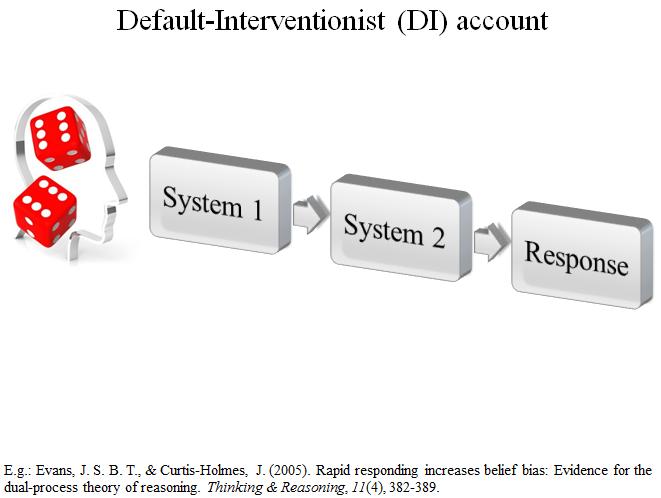
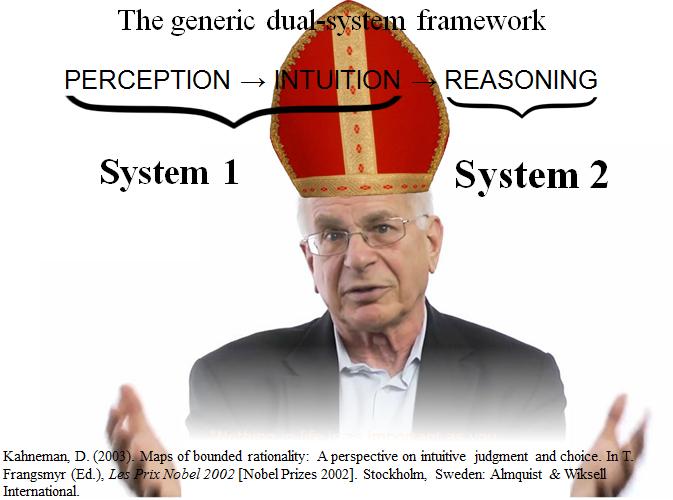
Dual process theory in psychology suggests that thinking operates via two distinct systems: an implicit system, which is automatic and unconscious, and an explicit system, which is controlled and conscious. Explicit attitudes and behaviors can be modified relatively quickly through persuasion or education, whereas implicit attitudes usually take longer to change and often require the establishment of new habits. These theories are central to various branches of psychology, including social, personality, cognitive, and clinical psychology. They also intersect with economics, especially in the contexts of prospect theory and behavioral economics, and are gaining prominence in sociological studies through cultural analysis.
* * *
Dual-process models of cognition: A multifarious nomenclature (or a terminological pandemonium)
automatic vs. controlled (Kahneman, 2003)
associative vs. rule based (Sloman, 1996)
heuristic vs. analytic (Klaczynski, 2001)
personal vs. subpersonal (Frankish, 2009)
analogue vs. symbolic (Paivio, 1986)
reflexive vs. reflective (Lieberman et al., 2002)
heuristic vs. systematic (Chaiken, 1980)
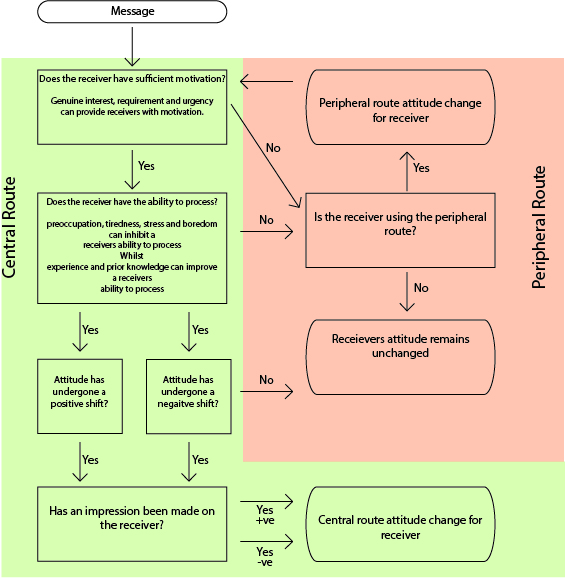
peripheral vs. central (Petty & Cacioppo, 1981)
implicit vs. explicit (Greenwald et al., 1998)
automatic vs. conscious (Baumeister, 2005)
experiential vs. noetic (Strack & Deutsch, 2004)
intuitive vs. reflective (Sperber, 1997)
associative vs. propositional (Gawronski & Bodenhausen, 2006)
etc. pp.
It has been noted that “what matters is not the specific names but the fact of duality” (Baumeister, 2005, p.75).
Summary of the features attributed to each system
System 1
System 2
Evolutionarily old
Unconcious, preconcious
Shared with animals
Implicit knowledge
Automatic
Fast
Parallel
High capacity
Intuitive
Contextualized
Pragmatic
Associative
Independent of general intelligence
Evolutionarily recent
Concious
Uniquely (distinctively) human
Explicit knowledge
Controlled
Slow
Sequential
Low capacity
Reflective
Abstract
Logical
Rule-based
Linked to general intelligence
Adapted from Frankish, K. (2009). Systems and levels: Dual-system theorie and the personal-subpersonal distinction. In J. S. B. T. Evans & K. Frankish (Eds.), In two minds: Dual processes and beyond (p. 89-108). Oxford: Oxford University Press.
Further References
Groves, P. M., & Thompson, R. F.. (1970). Habituation: A dual-process theory. Psychological Review
“Presented a dual-process theory of response plasticity to repeated stimulation. 2 hypothetical processes, 1 decremental (habituation) and 1 incremental (sensitization), are assumed to develop independently in the cns and interact to yield the final behavioral outcome. behavioral experiments are presented, using both the hindlimb flexion reflex of acute spinal cat and the acoustic startle response of intact rat, which are consistent with this theory. neurophysiological experiments indicate that the 2 processes have separate and distinct neuronal substrates. the dual-process theory and other current theories of response habituation are evaluated in terms of these and other recent findings. (6 p. ref.)”
Wixted, J. T.. (2007). Dual-process theory and signal-detection theory of recognition memory. Psychological Review
“Two influential models of recognition memory, the unequal-variance signal-detection model and a dual-process threshold/detection model, accurately describe the receiver operating characteristic, but only the latter model can provide estimates of recollection and familiarity. such estimates often accord with those provided by the remember-know procedure, and both methods are now widely used in the neuroscience literature to identify the brain correlates of recollection and familiarity. however, in recent years, a substantial literature has accumulated directly contrasting the signal-detection model against the threshold/detection model, and that literature is almost unanimous in its endorsement of signal-detection theory. a dual-process version of signal-detection theory implies that individual recognition decisions are not process pure, and it suggests new ways to investigate the brain correlates of recognition memory.”
Greene, J. D.. (2009). Dual-process morality and the personal/impersonal distinction: A reply to McGuire, Langdon, Coltheart, and Mackenzie. Journal of Experimental Social Psychology
Stanovich, K. E.. (2012). Distinguishing the reflective, algorithmic, and autonomous minds: Is it time for a tri-process theory?. In In Two Minds: Dual Processes and Beyond
“Building upon work which considers the implications dual-process theory for the great rationality debate in cognitive science, this chapter advances that discussion, first by discussing additions and complications to dual-process theory and then by working through the implications of these ideas for our view of human rationality. it argues that system 2 needs to be understood in terms of two levels of processing: the algorithmic and the reflective.”
Pelaccia, T., Tardif, J., Triby, E., & Charlin, B.. (2011). An analysis of clinical reasoning through a recent and comprehensive approach: The dual-process theory. Medical Education Online
“CONTEXT: clinical reasoning plays a major role in the ability of doctors to make diagnoses and decisions. it is considered as the physician’s most critical competence, and has been widely studied by physicians, educationalists, psychologists and sociologists. since the 1970s, many theories about clinical reasoning in medicine have been put forward. purpose: this paper aims at exploring a comprehensive approach: the ‘dual-process theory’, a model developed by cognitive psychologists over the last few years. discussion: after 40 years of sometimes contradictory studies on clinical reasoning, the dual-process theory gives us many answers on how doctors think while making diagnoses and decisions. it highlights the importance of physicians’ intuition and the high level of interaction between analytical and non-analytical processes. however, it has not received much attention in the medical education literature. the implications of dual-process models of reasoning in terms of medical education will be discussed.”
Petty, R. E., & Wegener, D. T.. (1999). The Elaboration Likelihood Model: Current status and controversies. Dual Process Theories in Social Psychology
“The elm contends information gets processed either centrally (effortful, scrutiny) or peripherally (heuristics) depending on their motivation and ability to process the information. this chapter looks back on 20 years of research since the ‘two routes to persuasion’ (central and peripheral) was introduced (petty, 1977; petty and cacioppo, 1981). the chapter provides an overview of the model in order to discuss some of the major conceputal questions and confusions that have arisen. the seven postulates of the theory are presented and the research related to them is reviewed. the current status of the elaboration likelihood model (elm) as a theory of persuastion and of social judgment is reviewed. elm overview: in 1977, petty introduced the idea of two routes of persuasion positing that central and peripheral processing occurred. the elm was formulated as a theory about how the classic the source (expertise), message (number of arguments), recipient (mood), and contextual (distraction) variables have an impact on attitudes towards various objects, issues, and people. more generally, the theory can be used to understand how any external or internal variable has an impact on some evaluative or nonevaluative judgement. central-route attitude changes are those that are based on relatively extensive and effortful information-processing activity, aimed at scrutinizing and uncoverying the central merits of the issue or advocacy. peripheral-route attitude changes are based on a variety of attitude change processes that typically require less cognitive effort. they may differ in quantitative or qualitative ways from the central process route. the central construct is the elaboration continuum. at the high end of the elaboration continuum, people assess object-relevant information in relation to knowledge that they already posses, and arrive at a reasoned attitude that is well articulated and bolstered by supporting information. at the low end, information scrutiny is reduced. where one lies on the continuum is determined by the motivation and ability of the perceiver on the issue. the continuum is supported by the idea that people are sometimes cognitive misers (taylor, 1981), but at other times it pays to use more cognitive resources. see summary graph pg 43. seven postulates: postulate 1: the correctness postulate – people are motivated to hold correct attitudes. sumary 1: at the conscious level, people want to hold opinoins that are correct. in the absence of o…”
Barrouillet, P.. (2011). Dual-process theories and cognitive development: Advances and challenges. Developmental Review
Greene, J. D., Morelli, S. A., Lowenberg, K., Nystrom, L. E., & Cohen, J. D.. (2008). Cognitive load selectively interferes with utilitarian moral judgment. Cognition
“This article begins with a brief review of the current literature on the structure and measurement of perfectionism. it is concluded from this review that 2 major types can be distinguished: a normal/healthy form and a pathological form. these 2 forms are then defined as positive and negative perfectionism and related directly to skinnerian concepts of positive and negative reinforcement. the positive/negative distinction is then further elaborated on in terms of approach/avoidance behavior, goal differences, self-concept involvement, emotional correlates, and the promoting environment. finally, some of the more obvious theoretical and practical implications are briefly explored. (psycinfo database record (c) 2008 apa, all rights reserved).”
Sowden, P. T., Pringle, A., & Gabora, L.. (2015). The shifting sands of creative thinking: Connections to dual-process theory. Thinking and Reasoning
“Dual-process models of cognition suggest that there are two types of thought: autonomous type 1 processes and working memory dependent type 2 processes that support hypothetical thinking. models of creative thinking also distinguish between two sets of thinking processes: those involved in the generation of ideas and those involved with their refinement, evaluation, and/or selection. here we review dual-process models in both these literatures and delineate the similarities and differences. both generative creative processing and evaluative creative processing involve elements that have been attributed to each of the dual processes of cognition. we explore the notion that creative thinking may rest upon the nature of a shifting process between type 1 and type 2 dual processes. we suggest that a synthesis of the evidence bases on dual-process models of cognition and of creative thinking, together with developing time-based approaches to explore the shifting process, could better inform the development of interventions to facilitate creativity.”
Smith, E. R., & DeCoster, J.. (2000). Dual-process models in social and cognitive psychology: Conceptual integration and links to underlying memory systems. Personality and Social Psychology Review
“Two experiments were conducted to assess the impact of status differentials on subgroup attitudes and behaviours. in experiment 1, 73 math-science students were led to believe they had higher or lower status than humanities students. they then performed a non-interactive decision-making task during which they were categorized exclusively as a university student (superordinate condition), or as a university student and math-science student simultaneously (subgroups condition). experiment 2 (n = 98) differed from experiment 1 in that perceptions of relative subgroup status were measured rather than manipulated. consistent with social identity theory, subgroup members tended to categorize themselves more at the superordinate (university) level the lower status they considered their subgroup to be. in experiment 2, a series of interactions also emerged, showing that status and inter-subgroup bias were positively related when the participants had been categorized exclusively at the superordinate level. when superordinate and subgroup identities were activated simultaneously, perceptions of status had no effect on levels of bias. the results were interpreted in terms of participants’ needs for identity enhancement and identity distinctiveness.”
Pyszczynski, T., Solomon, S., & Greenberg, J.. (1999). A dual-process model of defense against conscious and unconscious death-related thoughts: An extension of terror management theory. Psychological Review
“Distinct defensive processes are activated by conscious and nonconscious but accessible thoughts of death. proximal defenses, which entail suppressing death-related thoughts or pushing the problem of death into the distant future by denying one’s vulnerability, are rational, threat-focused, and activated when thoughts of death are in current focal attention. distal terror management defenses, which entail maintaining self-esteem and faith in one’s cultural worldview, function to control the potential for anxiety that results from knowing that death is inevitable. these defenses are experiential, are not related to the problem of death in any semantic or logical way, and are increasingly activated as the accessibility of death-related thoughts increases, up to the point at which such thoughts enter consciousness and proximal threat-focused defenses are initiated. experimental evidence for this analysis is presented. (psycinfo database record (c) 2013 apa, all rights reserved). (journal abstract)”
Knowles, E. S., & Condon, C. A.. (1999). Why people say “yes”: A dual-process theory of acquiescence. Journal of Personality and Social Psychology
“In 3 studies the authors investigated yea-saying acquiescence from the standpoint of d. t. gilbert’s (1991) 2-stage model of comprehension, wherein comprehension requires automatic acceptance during the first stage, which is then reconsidered and evaluated during a more effortful second stage.”
Gawronski, B.. (2013). What should we expect from a dual-process theory of preference construction in choice?. Journal of Consumer Psychology
“The hypothesis that human reasoning and decision-making can be roughly modeled by expected utility theory has been at the core of decision science. accumulating evidence has led researchers to modify the hypothesis. one of the latest additions to the field is dual process theory, which attempts to explain variance between participants and tasks when it comes to deviations from expected utility theory. it is argued that dual process theories at this point cannot replace previous theories, since they, among other things, lack a firm conceptual framework, and have no means of producing independent evidence for their case.”
De Neys, W.. (2017). Dual process theory 2.0. Dual Process Theory 2.0
“In psychology, a dual process theory provides an account of how a phenomenon can occur in two different ways, or as a result of two different processes. often, the two processes consist of an implicit (automatic), unconscious process and an explicit (controlled), conscious process. verbalized explicit processes or attitudes and actions may change with persuasion or education; though implicit process or attitudes usually take a long amount of time to change with the forming of new habits. dual process theories can be found in social, personality, cognitive, and clinical psychology.”
Reyna, V. F.. (2004). How People Make Decisions That Involve Risk: A Dual-Processes Approach. Current Directions in Psychological Science
“Many health and safety problems, including war and terrorism, are by-products of how people reason about risk. i describe a new approach to reasoning about risk that imple-ments a modern dual-process model of memory called fuzzy-trace theory. this approach posits encoding of both verbatim and gist representations, with reliance on the latter whenever possible; dependence of reasoning on retrieval cues that access stored values and principles; and vulnerability of reasoning to processing interference from overlapping classes of events, which causes denominator neglect in risk or probability judg-ments. these simple principles explain classic and new findings, for example, the finding that people overestimate small risks but ignore very small risks. fuzzy-trace theory differs from other dual-process approaches to reasoning in that it places intuition at the apex of development, considering fuzzy intuitive process-ing more advanced than precise computational processing (e.g., trading off risks and rewards). the theory supplies a conception of rationality that distinguishes degrees of severity of errors in reasoning. it also includes a mechanism for achieving con-sistency in reasoning, a hallmark of rationality, by explaining how a person can treat superficially different reasoning problems in the same way if the problems share an underlying gist. keywords—risk perception; risky decision making; fuzzy-trace theory; intuition; dual processes in reasoning as i write these words, coalition troops are at war in iraq. the decision to go to war with iraq, like many decisions, was based on a perception of risk, that is, the perceived threat posed by iraq under saddam hussein. key government officials also believed that inaction with respect to iraq posed a greater risk than taking action. since sep-tember 11, 2001, foreign threats and risks of terrorism have loomed large in people’s perception, dwarfing perennial killers such as highway accidents and heart disease. in this article, i discuss the psychological factors that shape the perception of many kinds of risks and the decisions that involve those risks.”
Bago, B., & De Neys, W.. (2017). Fast logic?: Examining the time course assumption of dual process theory. Cognition
“Influential dual process models of human thinking posit that reasoners typically produce a fast, intuitive heuristic (i.e., type-1) response which might subsequently be overridden and corrected by slower, deliberative processing (i.e., type-2). in this study we directly tested this time course assumption. we used a two response paradigm in which participants have to give an immediate answer and afterwards are allowed extra time before giving a final response. in four experiments we used a range of procedures (e.g., challenging response deadline, concurrent load) to knock out type 2 processing and make sure that the initial response was intuitive in nature. our key finding is that we frequently observe correct, logical responses as the first, immediate response. response confidence and latency analyses indicate that these initial correct responses are given fast, with high confidence, and in the face of conflicting heuristic responses. findings suggest that fast and automatic type 1 processing also cues a correct logical response from the start. we sketch a revised dual process model in which the relative strength of different types of intuitions determines reasoning performance.”
The elaboration likelihood model (acronymised as ELM) of persuasion is a dual process theory describing the change of attitudes. The ELM was developed by Richard E. Petty and John Cacioppo in 1986. The model aims to explain different ways of processing stimuli, why they are used, and their outcomes on attitude change. The ELM proposes two major routes to persuasion: the central route and the peripheral route.
Remark: An argumentum ab inconvenienti is one based on the difficulties involved in pursuing a line of reasoning, and is thus a form of appeal to consequences.
“The elaboration likelihood model (elm) of → persuasion, developed by richard petty, john cacioppo, and their collaborators, is an example of a ‘dual‐process’ approach to persuasion (another example is chaiken’s heuristic‐systematic model, hsm). the elm suggests that important variations in the nature of persuasion are a function of the likelihood that receivers will engage in elaboration of (that is, thinking about) information relevant to the persuasive issue. depending on the degree of elaboration, two different kinds of persuasion process can be engaged – one involving systematic thinking and the other involving cognitive shortcuts. different factors influence persuasive outcomes depending on which process is activated.”
Petty, R. E., & Bri??ol, P.. (2012). The elaboration likelihood model. In Handbook of Theories of Social Psychology: Volume 1
“The elaboration likelihood model states that there are two routes through which persuasive messages are processed: the central route, which provides complete information and is straightforward, and the peripheral route, which uses means like catchy tunes, colors, and celebrity endorsements.”
Petty, R. E., & Wegener, D. T.. (1999). The Elaboration Likelihood Model: Current status and controversies. Dual Process Theories in Social Psychology
“The elm contends information gets processed either centrally (effortful, scrutiny) or peripherally (heuristics) depending on their motivation and ability to process the information. this chapter looks back on 20 years of research since the ‘two routes to persuasion’ (central and peripheral) was introduced (petty, 1977; petty and cacioppo, 1981). the chapter provides an overview of the model in order to discuss some of the major conceputal questions and confusions that have arisen. the seven postulates of the theory are presented and the research related to them is reviewed. the current status of the elaboration likelihood model (elm) as a theory of persuastion and of social judgment is reviewed. elm overview: in 1977, petty introduced the idea of two routes of persuasion positing that central and peripheral processing occurred. the elm was formulated as a theory about how the classic the source (expertise), message (number of arguments), recipient (mood), and contextual (distraction) variables have an impact on attitudes towards various objects, issues, and people. more generally, the theory can be used to understand how any external or internal variable has an impact on some evaluative or nonevaluative judgement. central-route attitude changes are those that are based on relatively extensive and effortful information-processing activity, aimed at scrutinizing and uncoverying the central merits of the issue or advocacy. peripheral-route attitude changes are based on a variety of attitude change processes that typically require less cognitive effort. they may differ in quantitative or qualitative ways from the central process route. the central construct is the elaboration continuum. at the high end of the elaboration continuum, people assess object-relevant information in relation to knowledge that they already posses, and arrive at a reasoned attitude that is well articulated and bolstered by supporting information. at the low end, information scrutiny is reduced. where one lies on the continuum is determined by the motivation and ability of the perceiver on the issue. the continuum is supported by the idea that people are sometimes cognitive misers (taylor, 1981), but at other times it pays to use more cognitive resources. see summary graph pg 43. seven postulates: postulate 1: the correctness postulate – people are motivated to hold correct attitudes. sumary 1: at the conscious level, people want to hold opinoins that are correct. in the absence of o…”
Kitchen, P. J., Kerr, G., Schultz, D. E., McColl, R., & Pals, H.. (2014). The elaboration likelihood model: Review, critique and research agenda. European Journal of Marketing
“Purpose – the purpose of this paper is to review, critique and develop a research agenda for the elaboration likelihood model (elm). the model was introduced by petty and cacioppo over three decades ago and has been modified, revised and extended. given modern communication contexts, it is appropriate to question the model’s validity and relevance. design/methodology/approach – the authors develop a conceptual approach, based on a fully comprehensive and extensive review and critique of elm and its development since its inception. findings – this paper focuses on major issues concerning the elm. these include model assumptions and its descriptive nature; continuum questions, multi-channel processing and mediating variables before turning to the need to replicate the elm and to offer recommendations for its future development. research limitations/implications – this paper offers a series of questions in terms of research implications. these include whether elm could or should be replicated, its extension, a greater conceptualization of argument quality, an explanation of movement along the continuum and between central and peripheral routes to persuasion, or to use new methodologies and technologies to help better understanding consume thinking and behaviour? all these relate to the current need to explore the relevance of elm in a more modern context. practical implications – it is time to question the validity and relevance of the elm. the diversity of on- and off-line media options and the variants of consumer choice raise significant issues. originality/value – while theelmmodel continues to be widely cited and taught as one of the major cornerstones of persuasion, questions are raised concerning its relevance and validity in 21st century communication contexts.”
Tam, K. Y., & Ho, S. Y.. (2005). Web personalization as a persuasion strategy: An elaboration likelihood model perspective. Information Systems Research
“W ith advances in tracking and database technologies, firms are increasingly able to understand their cus-tomers and translate this understanding into products and services that appeal to them. technologies such as collaborative filtering, data mining, and click-stream analysis enable firms to customize their offerings at the individual level. while there has been a lot of hype about web personalization recently, our understand-ing of its effectiveness is far from conclusive. drawing on the elaboration likelihood model (elm) literature, this research takes the view that the interaction between a firm and its customers is one of communicating a persuasive message to the customers driven by business objectives. in particular, we examine three major elements of a web personalization strategy: level of preference matching, recommendation set size, and sorting cue. these elements can be manipulated by a firm in implementing its personalization strategy. this research also investigates a personal disposition, need for cognition, which plays a role in assessing the effectiveness of web personalization. research hypotheses are tested using 1,000 subjects in three field experiments based on a ring-tone download website. our findings indicate the saliency of these variables in different stages of the persuasion process. theoretical and practical implications of the findings are discussed.”
Bhattacherjee, & Sanford. (2006). Influence Processes for Information Technology Acceptance: An Elaboration Likelihood Model. MIS Quarterly
“This study examines how processes of external influence shape information technology acceptance among potential users, how such influence effects vary across a user population, and whether these effects are persistent over time. drawing on the elaboration-likelihood model (elm), we compared two alternative influenceprocesses, the central and peripheral routes, in motivating it acceptance. these processes were respectively operationalized using the argument quality and source credibility constructs, and linked to perceived usefulness and attitude, the core perceptual drivers of it acceptance. we further examined how these influenceprocesses were moderated by users’ it expertise and perceived job relevance and the temporal stability of such influence effects. nine hypotheses thus developed were empirically validated using a field survey of document management system acceptance at an eastern european governmental agency. this study contributes to the it acceptance literature by introducing elm as a referent theory for acceptance research, by elaborating alternative modes of influence, and by specifying factors moderating their effects. for practitioners, this study introduces influence processes as policy tools that managers can employ to motivate it acceptance within their organizations, benchmarks alternative influence strategies, and demonstrates the need for customizing influence strategies to the specific needs of a user population. abstract from author copyright of mis quarterly is the property of mis quarterly & the society for information management and its content may not be copied or emailed to multiple sites or posted to a listserv without the copyright holder’s express written permission. however, users may print, download, or email articles for individual use. this abstract may be abridged. no warranty is given about the accuracy of the copy. users should refer to the original published version of the material for the full abstract. (copyright applies to all abstracts.)”
Sher, P. J., & Lee, S.-H.. (2009). Consumer skepticism and online reviews: An Elaboration Likelihood Model perspective. Social Behavior and Personality: An International Journal
“Online consumers vary in their tendency to believe or disbelieve online reviews. based on an elaboration likelihood model (elm; petty & cacioppo, 1981, 1986), the present study tested the effects of consumer skepticism on online consumers. a total of 278 undergraduates expressed their attitudes about a product in an online experiment. two findings emerged from the results. first, highly skeptical consumers tend to base their attitudes on intrinsic beliefs instead of situational factors; that is, they are biased against certain types of information and indifferent to the message quality. second, consumers with low skepticism tend to adopt the peripheral route in forming attitude; that is, they are more persuaded by review quantity. these findings contribute to the elm research literature by considering a potentially important personality factor in the elm framework. managerial implications are suggested. [abstract from author]ncopyright of social behavior & personality: an international journal is the property of society for personality research and its content may not be copied or emailed to multiple sites or posted to a listserv without the copyright holder’s express written permission. however, users may print, download, or email articles for individual use. this abstract may be abridged. no warranty is given about the accuracy of the copy. users should refer to the original published version of the material for the full abstract. (copyright applies to all abstracts.)”
Cho, C. H.. (1999). How advertising works on the WWW: Modified elaboration likelihood model. Journal of Current Issues and Research in Advertising
“This paper develops a model called modified elaboration likelihood model to understand how people process advertising on the internet. an empirical study verifies the new model by examining several variables influencing voluntary exposure or clicking of banner ads. these variables include (a) level of personal and product involvement, (b) the size of a banner ad, (c) relevancy between the content of a vehicle and the product category of a banner ad, (d) attitude toward the vehicle, and (e) overall attitude toward web advertising. the findings document significant relationships between these variables and clicking of banner ads and support the hypothesized model.”
Allison, T. H., Davis, B. C., Webb, J. W., & Short, J. C.. (2017). Persuasion in crowdfunding: An elaboration likelihood model of crowdfunding performance. Journal of Business Venturing
“This study draws upon the elaboration likelihood model of persuasion (elm) to develop and test a model of persuasiveinfluence in crowdfunding. to test our hypothesized relationships, we drew upon a sample of 383 ventures taken directly from kickstarter, coupled with a decision experiment conducted in a simulated crowdfunding context. results suggest that issue-relevant information, such as entrepreneurs’ education, matters most when funders possess greater ability and motivation to make careful evaluations. in contrast, cues, such as adopting a group identity, have their strongest influence among inexperienced, first-time funders, and when requested funding amounts are smaller.”
Lien, N.-H.. (2001). Elaboration Likelihood Model in consumer research: A review. Proceedings of the National Science Council
Show/hide publication abstract
“The elm is a model of information processing and persuasion. ever since its introduction in the 1980’s, elm has been frequently cited by scholars from both cognitive/social psychology and consumer research. this paper reviews the application of elm to consumer research over the past decade, with the focus on studies conducted in advertising contexts, effects on brand evaluations, specification of processing mechanisms, and findings that seem to extend or contradict the model. a body of literature is discussed in three domains: antecedents, processes, and processing cues. a brief intepretation for the review and future directons for research are presented.”
Angst, & Agarwal. (2009). Adoption of Electronic Health Records in the Presence of Privacy Concerns: The Elaboration Likelihood Model and Individual Persuasion. MIS Quarterly
“Within the emerging context of the digitization of health care, electronic health records (ehrs) constitute a significant technological advance in the way medical information is stored, communicated, and processed by the multiple parties involved in health care delivery. however, in spite of the anticipated value potential of this technology, there is widespread concern that consumer privacy issues may impede its diffusion. in this study, we pose the question: can individuals be persuaded to change their attitudes and opt-in behavioral intentions toward ehrs, and allow their medical information to be digitized even in the presence of significant privacy concerns? to investigate this question, we integrate an individual’s concern for information privacy (cfip) with the elaboration likelihood model (elm) to examine attitude change and likelihood of opting-in to an ehr system. we theorize that issue involvement and argument framing interact to influence attitude change, and that concern for information privacy further moderates the effects of these variables. we also propose that likelihood of adoption is driven by concern for information privacy and attitude. we test our predictions using an experiment with 366 subjects where we manipulate the framing of the arguments supporting ehrs. we find that an individual’s cfip interacts with argument framing and issue involvement to affect attitudes toward the use of ehrs. in addition, results suggest that attitude toward ehr use and cfip directly influence opt-in behavioral intentions. an important finding for both theory and practice is that even when people have high concerns for privacy, their attitudes can be positively altered with appropriate message framing. these results as well as other theoretical and practical implications are discussed.”
Frewer, L. J., Howard, C., Hedderley, D., & Shepherd, R.. (1997). The elaboration likelihood model and communication about food risks. Risk Analysis
“Factors such as hazard type and source credibility have been identified as important in the establishment of effective strategies for risk communication. the elaboration likelihood model was adapted to investigate the potential impact of hazard type, information source, and persuasive content of information on individual engagement in elaborative, or thoughtful, cognitions about risk messages. one hundred sixty respondents were allocated to one of eight experimental groups, and the effects of source credibility, persuasive content of information and hazard type were systematically varied. the impact of the different factors on beliefs about the information and elaborative processing examined. low credibility was particularly important in reducing risk perceptions, although persuasive content and hazard type were also influential in determining whether elaborative processing occurred.”
Yang, S. F.. (2015). An eye-tracking study of the Elaboration Likelihood Model in online shopping. Electronic Commerce Research and Applications
“Abstract this study uses eye-tracking to explore the elaboration likelihood model (elm) in online shopping. the results show that the peripheral cue did not have moderating effect on purchase intention, but had moderating effect on eye movement. regarding purchase intention, the high elaboration had higher purchase intention than the low elaboration with a positive peripheral cue, but there was no difference in purchase intention between the high and low elaboration with a negative peripheral cue. regarding eye movement, with a positive peripheral cue, the high elaboration group was observed to have longer fixation duration than the low elaboration group in two areas of interest (aois); however, with a negative peripheral cue, the low elaboration group had longer fixation on the whole page and two aois. in addition, the relationship between purchase intention and eye movement of the aois is more significant in the high elaboration group when given a negative peripheral cue and in the low elaboration group when given a positive peripheral cue. this study not only examines the postulates of the elm, but also contributes to a better understanding of the cognitive processes of the elm. these findings have practical implications for e-sellers to identify characteristics of consumers’ elaboration in eye movement and designing customization and persuasivecontext for different elaboration groups in e-commerce.”
Petty, R. E., Brinol, P., & Priester, J. R.. (2002). Mass media attitude change: Implications of the Elaboration Likelihood Model of Persuasion. . In Media effects: Advances in theory and research
“Undoubtedly, few social scientists today think that the mass media have the power to sway huge audiences to the extent once believed likely. nevertheless, the technological advances of the last century – from the first primitive radio broadcasts to today’s high speed mobile internet devices – have made it possible for individual communicators to have access to unprecendented numbers of potential message recipients, and recipients to a constant barrage of messages. millions of dollars are spent worldwide each year in attempts to change people’s attidudes about political candidates, consumer products, health and safety practices, and charitable causes. in most of these instances, the ultimate goal is to influence people’s behaviour so that they will vote for certain politicians or referenda, purchase specific goods, engage in safer driving, eating, and sexual activities, and donate money to various religious, environmental, and educational organizations and institutions. to what extent are media persuasion attempts effective?”
Morris, J. D., Woo, C., & Singh, A. J.. (2005). Elaboration likelihood model: A missing intrinsic emotional implication. Journal of Targeting, Measurement and Analysis for Marketing
“The elaboration likelihood model (elm), developed by petty and cacioppo, proposed two routes to attitude change: central and peripheral. the central route emphasises a high relevance of the message to the individual. in the peripheral route, the individual concentrates on heuristic cues like attractive expert sources and number rather than the content of arguments employed by the message to process the message. if these cues produce an attitude change, this change is likely to be shorter lasting and unpredictable of that individual’s behaviour. hence, the cognitive (central) aspect of the elm overshadows its affective (peripheral) aspect, and the underlying suggestion of this model is that an attitude change is mostly reached through cognition as opposed to emotion. this study attempts to show that the emotional aspect is as important as the cognitive aspect. the basis for this conclusion is that even as an individual processes a message cognitively, that cognition has an emotional core. in addition, there is a possibility that content processing (elaboration) gives rise to emotions and that this leads to a longer-lasting change in attitudes.”
Bitner, M. J., & Obermiller, C.. (1985). THE ELABORATION LIKELIHOOD MODEL: LIMITATIONS AND EXTENSIONS IN MARKETING. Advances in Consumer Research
“The elaboration likelihood model (petty and cacioppo 1981) is discussed as a framework for understanding attitude formation and change with regard to products :ind services. the model has a number of limitations, some general and some specifically relevant to applica- tions in consumer behavior and marketing. these limita- tions are presented and discussed along with suggestions for research. despite its underspecification, the tnodel is seen as a useful framework and the authors propose a number of specific marketing modiatars of elaboration iikelihood. in marketing a great deal of attention has been focused on attitude formation, attitude change and attitude measurement with respect to products and services. since 1970, the literature reflects strong interest in the application and development of tnultiattribute atti- lude models (wilkie and pessemier 1973; lutz 1981). lndustry applications have also relied heavily on survey methodologies and multiattribute approaches to measure .ittitudes toward and preferences for products and servi- i:es. the multiattribute method assumes that consumers s.an and do base their choice decisions on beliefs about [iroduct/service attributes. marketing strategies evolving out of this approach to attitude formation fo- cus on analyzing and communicating information about important product/service attributes. at the same time there has been substantial research in marketing to suggest that there are external cues or in- lernal psychological processes quite separate from care- ful consideration of specific product/service attributes lhat may influence consumers’ attitudes. halo effect phenomena (beckwith and lehmann 1975; mitchell and olson 1981), attitude change via classical conditioning (gorn 1982), behavior modification (nord and peter 1980), mere fxposure effects (obermiller 1984), self-perception theory (reingen and kernan 1977), and the application of simple decision rules are examples of this view of atti- lude formation and change. marketing strategies evolv- ing out of this approach focus less on specific product/ service attributes and more on understanding the effects of contextual cues and heuristics on evaluation and de- cision making. these two approaches to attitude formation and change can be classified under what petty and cacioppo (1981; 1983) refer to in their elaboration likelihood model (elm) as central and peripheral routes to persuasion. the model proposes that neither route alone can account for th…”
Douglas, S. C., Kiewitz, C., Martinko, M. I., Harvey, P., Younhee, K. I. M., & Jae, U. C.. (2008). Cognitions, emotions, and evaluations: An elaboration likelihood model for workplace aggression. Academy of Management Review
“We present a model that captures processes leading to aggressive behaviors in the workplace. starting with trigger events, the model outlines the development of aggressive behaviors via three processing routes that vary in their level of deliberate, mindful processing. the model outlines how repeated exposure to trigger events can lead to the escalation of workplace aggression while also highlighting the moderating role of such factors as an individual’s level of self-control and attitude toward revenge. [abstract from author]”
Zhou, T.. (2017). Understanding location-based services users’ privacy concern: An elaboration likelihood model perspective. Internet Research
“Due to the high perceived risk, building users’ initial trust is crucial to facilitating their adoption and usage of mobile banking. drawing on the elaboration likelihood model (elm), this research examined users’ initial trust in mobile banking. the results indicated that initial trust develops along a dual route including the central route and peripheral route. self-efficacy as the elaboration likelihood moderates the effects of central cues and peripheral cues on initial trust. central cues include information quality and service quality, whereas peripheral cues include system quality, structural assurance and reputation. the results imply that service providers need to employ differentiated strategies to build users’ initial trust in mobile banking.”
Fan, Y., & Miao, Y.. (2012). Effect of Electronic Word-of-Mouth on Consumer Purchase Intention : The Perspective of Gender Differences. International Journal of Electronic Business Management
Show/hide publication abstract
“Electronic word of mouth is available to customers in different types of online consumer reviews, which can be used to help them make e-commerce purchasing decisions. customers acknowledge that online consumer reviews help them to determine ewom credibility and to make purchasing decisions. this study uses surveys and multiple regression analysis to create an extended elaboration likelihood model that describes the relationship between customer expertise, involvement, and rapport to acceptance and use of electronic word of mouth in making purchasing decisions. the study focuses on the cultural effects of gender on the extended elaboration likelihood model and purchasing decisions in e-commerce virtual communities. study results show that involvement has the most significant effect on perceived ewom credibility. study results show that perceived ewom credibility has a significant effect on ewom acceptance and intent to purchase. study results also show the male customers have different e-commerce shopping behaviors than female customers.”
Roberson, Q. M., Collins, C. J., & Oreg, S.. (2005). The effects of recruitment message specificity on applicant attraction to organizations. Journal of Business and Psychology
“We used the elaboration likelihood model (elm) from marketing research to explain and examine how recruitment message specificity influences job seeker attraction to organizations.”
Gregory, C. K., Meade, A. W., & Thompson, L. F.. (2013). Understanding internet recruitment via signaling theory and the elaboration likelihood model. Computers in Human Behavior
“In a series of experiments, we investigated the effect of race of source on persuasive communications in the elaboration likelihood model (r. e. petty & j. t. cacioppo, 1981, 1986). in exp 1, we found no evidence that white participants responded to a black source as a simple negative cue. exp 2 suggested the possibility that exposure to a black source led to low-involvement message processing. in exps 3 and 4, a distraction paradigm was used to test this possibility, and it was found that participants under low involvement were highly motivated to process a message presented by a black source. in exp 5, we found that attitudes toward the source’s ethnic group, rather than violations of expectancies, accounted for this processing effect. taken together, the results of these experiments are consistent with s. l. gaertner and j. f. dovidio’s (1986) theory of aversive racism, which suggests that whites, because of a combination of egalitarian values and underlying negative racial attitudes, are very concerned about not appearing unfavorable toward blacks, leading them to be highly motivated to process messages presented by a source from this group.”
Fallis, A. .. (2013). THE ROLE OF ARGUMENT QUALITY IN THE ELABORATION LIKELIHOOD MODEL. Journal of Chemical Information and Modeling
“Examines the conceptualization and manipulation of the argument quality construct in the elaboration likelihood model (elm). development of a conceptual definition of argument quality; importance of elm to consumer research; components of elm.”
Zhou, T.. (2012). Understanding users’ initial trust in mobile banking: An elaboration likelihood perspective. Computers in Human Behavior










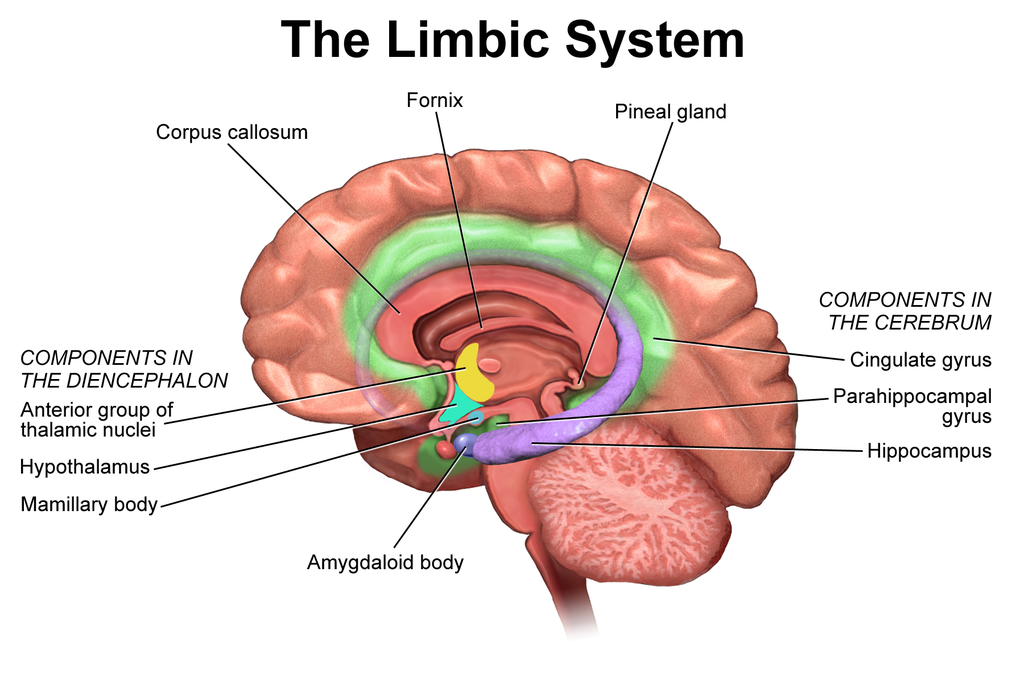
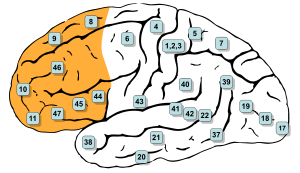


 More at Wikipedia