Family based QTL mapping, or Family-pedigree based mapping (Linkage and association mapping), involves multiple families instead of a single family. Family based QTL mapping has been the only way for mapping of genes where experimental crosses are difficult to make. However, due to some advantages, now plant geneticists are attempting to incorporate some of the methods pioneered in human genetics.[20] Using family-pedigree based approach has been discussed (Bink et al. 2008). Family-based linkage and association has been successfully implemented (Rosyara et al. 2009)[21]
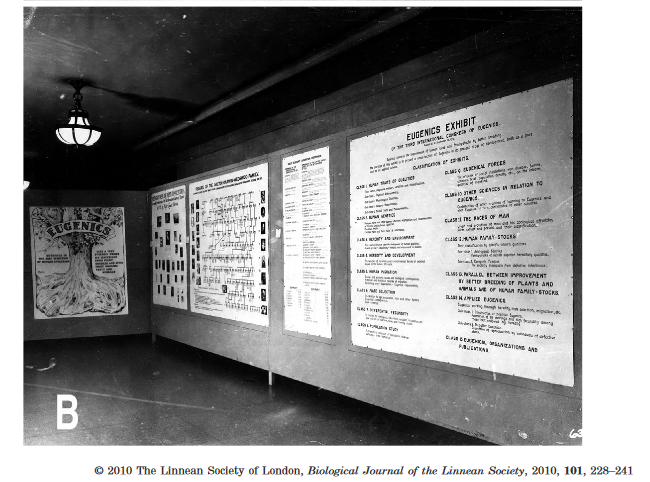
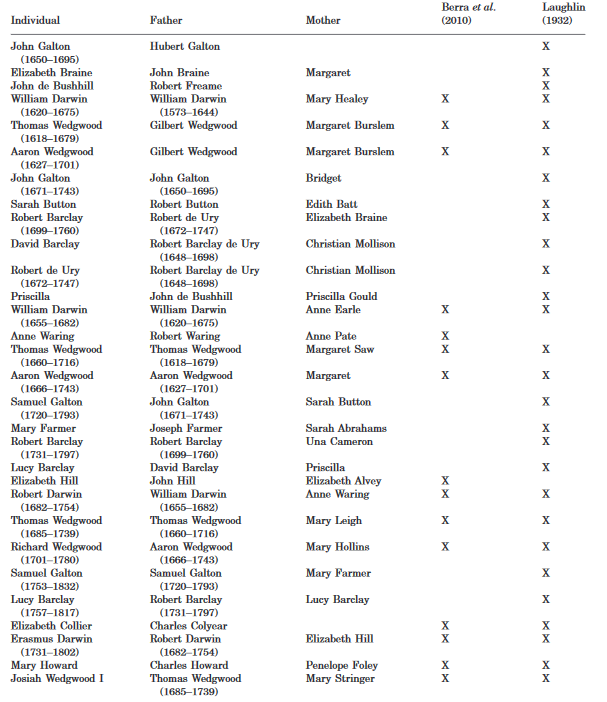
“A pedigree of the Galton–Darwin–Wedgwood families that was exhibited as a poster at the Third International Congress of Eugenics in 1932 at the American Museum of Natural History has been located in the archives of Truman State University in Kirksville, Missouri. This pedigree was prepared by Harry Hamilton Laughlin, Director of the Eugenics Record Office of the Carnegie Institute. The pedigree shows consanguineous marriages within the three families. A special collection of rare Darwin family photographs assembled by Leonard Darwin has also been found in the Truman State University archives. These photographs were exhibited as a poster alongside the pedigree at the 1932 Eugenics Congress. The poster of the Galton–Darwin–Wedgwood pedigree is published here, together with a tabular version providing ready access to the information contained in the pedigree. Also included are the Darwin family photographs and a biographical sketch of Laughlin.” (Berra, et al., 2010; see references below)
Page 1234
Further References
Berra, T. M., Alvarez, G., & Shannon, K.. (2010). The Galton-Darwin-Wedgwood Pedigree of H.H. Laughlin. Biological Journal of the Linnean Society
“A pedigree of the galton–darwin–wedgwood families that was exhibited as a poster at the third international congress of eugenics in 1932 at the american museum of natural history has been located in the archives of truman state university in kirksville, missouri. this pedigree was prepared by harry hamilton laughlin, director of the eugenics record office of the carnegie institute. the pedigree shows consanguineous marriages within the three families. a special collection of rare darwin family photographs assembled by leonard darwin has also been found in the truman state university archives. these photographs were exhibited as a poster alongside the pedigree at the 1932 eugenics congress. the poster of the galton–darwin–wedgwood pedigree is published here, together with a tabular version providing ready access to the information contained in the pedigree. also included are the darwin family photographs and a biographical sketch of laughlin.”
Berra, T. M., Alvarez, G., & Ceballos, F. C.. (2010). Was the Darwin/Wedgwood Dynasty Adversely Affected by Consanguinity?. BioScience
“Charles darwin, who was married to his first cousin, emma wedgwood, was one of the first experimentalists to demonstrate the adverse effects of inbreeding and to question the consequences of consanguineous mating. he documented the phenomenon of inbreeding depression for numerous plant species, and this caused him to worry about the health of his own children, who were often ill. to determine whether darwin’s fears were justified, we constructed a pedigree of the darwin/wedgwood dynasty from the large quantity of genealogical information published on these families. the inbreeding coefficients (f) computed from the pedigree show that darwin’s children were subject to a moderate level of inbreeding (f 5 0.0630), and the progeny of related families had still higher inbreeding values (e.g., f 5 0.1255 for the progeny of henry wedgwood, emma wedgwood’s brother). the analysis of a sample of 25 darwin/wedgwood families belonging to four consecutive generations shows a statistically significant positive association between child mortality (death at or before the age of 10 years) and inbreeding coefficient detected by means of nonparametric tests (? 5 0.309, p 5 0.040). our findings suggest that the high childhood mortality experienced by the darwin progeny (3 of his 10 children died at age 10 or younger) might be a result of increased homozygosity of deleterious recessive alleles produced by the consanguineous marriages within the darwin/wedgwood dynasty.”
Golubovsky, M.. (2008). Unexplained infertility in Charles Darwin’s family: Genetic aspect. Human Reproduction