
The Möbius band is an extraordinary geometrical figure. The band is eponymously named after the German mathematician August Ferdinand Möbius who described it in 1885, contemporaneously with another German mathematician named Johann Benedict Listing. It is a so called ruled surface with only one side and one boundary and it possesses the mathematical property of non-orientability (viz., a non-orientable manifold). In fact, the Möbius band is the simplest possible non-orientable surface. A Gedankenexperiment is helpful to understand this property intuitively: Imagine walking on the surface of a giant Möbius band. If you would travel long enough you would end up at the very starting point of the journey, only mirror-reversed. This journey can be repeated ad infinitum. Therefore, the Möbius band can also be interpreted as a metaphor for infinity, i.e., the beginningless and the endless. A similar principle can be found in the interpretation of the Ouroboros serpent (which eats its own tail), a gnostic symbol which originated in ancient Egyptian iconography (ἓν τὸ πᾶν – “The all is one”) in the 10th century. A similar symbolism could later also be found in the western Greek magical tradition (Ancient Greek: οὐροβόρος). The psychoanalytic meaning of the Ouroboros was discussed as an archetype by the depth-psychologist C.G. Jung.
The geometry of the Möbius band (also referred to as “Möbius strip”) has far-reaching interdisciplinary implications. The principles of its peculiar topology have been applied to a broad array of scientific disciplines including mathematics, cosmology, computer science, physics, chemistry, biology, psychology, et cetera. Practical applications include, for instance, superconductors with high transition temperatures, molecular engines, and bandpass filters (see exemplary references below).
In addition to its scientific relevance, the Möbius band can be found as a leitmotif in multifarious artworks across various cultures (for an example see the ancient mosaic depicted below).11. see also: Larison, Lorraine L. (1973). “The Möbius band in Roman mosaics”. American Scientist, 61, 544–547. ↩ Moreover, the abstract principles derived from its topological structure have been applied to music theory (e.g., the space of all two-note chords, referred to as dyads, resembles the shape of a Möbius band).
The Möbius band is a very interesting visual percept in the context of perceptual cognitive psychology and neuropsychology, as it helps researchers to investigate the cognitive and neuronal mechanism which undergird cognition and perception. (Besides, in the first half of the 20th century magicians used the Möbius band for “magical” tricks.)22. ↩ Interestingly, a recent series of fMRI neuroimaging studies focused on the topic of ego-dissolution which is associated with non-dual states of consciousness in which the border between self and other (the dichotomy between inside and outside) temporarily dissolves. The default-mode network33. 
This image shows main functional-structural connectome of the default mode network (yellow) and connectivity between the regions color-coded by structural traversing direction (xyz -> rgb). Click here for more infos ↩ appears to be an important neuroanatomical correlate in this context.
Next to its neuropsychological aspects, the Möbius band inspires profound philosophical contemplations concerning the relationship between mind & matter (e.g., the “Pauli-Jung conjecture”44. From the work of Wolfgang Pauli and Carl G. Jung results a philosophical approach, which Harald Atmanspacher titles the Pauli-Jung conjecture, of dual-aspect monism which has a very specific further feature, namely that different aspects may show a complementarity in a quantum physical sense. That is, the Pauli-Jung conjecture implies that with regard to mental and physical states there may be incompatible descriptions of different parts that emerge from the whole. This stands in close analogy to quantum physics, where complementary properties cannot be determined jointly with accuracy. ↩ in the context of dual aspect monism)55. In the philosophy of mind, double-aspect theory is the view that the mental and the physical are two aspects of, or perspectives on, the same substance. It is also called dual-aspect monism. The theory’s relationship to neutral monism is ill-defined, but one proffered distinction says that whereas neutral monism allows the context of a given group of neutral elements to determine whether the group is mental, physical, both, or neither, double-aspect theory requires the mental and the physical to be inseparable and mutually irreducible (though distinct). ↩. In the classical 17th century Cartesian framework (which is still highly influential), mind & matter (psyche & physis – or res extensa & res cogitans)66. Res extensa is one of the three substances described by René Descartes in his Cartesian ontology (often referred to as “radical dualism”), alongside “res cogitans” and “God”. Translated from Latin, “res extensa” means “extended thing”. Descartes often translated it as “corporeal substance”. In Descartes’ substance–attribute–mode ontology, extension is the primary attribute of corporeal substance. Descartes describes a piece of wax in the Second Meditation (see Wax argument). A solid piece of wax has certain sensory qualities. However, when the wax is melted, it loses every single apparent quality it had in its solid form. Still, Descartes recognizes in the melted substance the idea of wax. ↩ are two separate phenomena (this dichotomisation is known as Cartesian dualism or the Cartesian split). However, alternative ontological theories postulate that mind & matter are complementary with respect to each other (in the quantum physical sense of complementarity), i.e., they are different aspects of the same underlying “substance” (hence the term “monism” as opposed to “dualism”).
Currently, a dualistic mind/matter conception is the (mostly implicitly accepted) reigning scientific paradigm (cf. Thomas Kuhn)77. The Structure of Scientific Revolutions (1962; second edition 1970; third edition 1996; fourth edition 2012) is a book about the history of science by the philosopher Thomas S. Kuhn. Its publication was a landmark event in the history, philosophy, and sociology of scientific knowledge. Kuhn challenged the then prevailing view of progress in “normal science”. Normal scientific progress was viewed as “development-by-accumulation” of accepted facts and theories. Kuhn argued for an episodic model in which periods of such conceptual continuity in normal science were interrupted by periods of revolutionary science. The discovery of “anomalies” during revolutions in science leads to new paradigms. New paradigms then ask new questions of old data, move beyond the mere “puzzle-solving” of the previous paradigm, change the rules of the game and the “map” directing new research. ↩, particularly within the neurosciences (e.g., epiphenominalism/emergence theories of consciousness)88. Epiphenomenalism is a position on the mind–body problem which holds that physical and biochemical events within the human body (sense organs, neural impulses, and muscle contractions, for example) are causal with respect to mental events (thought, consciousness, and cognition). According to this view, subjective mental events are completely dependent for their existence on corresponding physical and biochemical events within the human body and themselves have no causal efficacy on physical events. The appearance that subjective mental states (such as intentions) influence physical events is merely an illusion. For instance, fear seems to make the heart beat faster, but according to epiphenomenalism the biochemical secretions of the brain and nervous system (such as adrenaline)—not the experience of fear—is what raises the heartbeat. Because mental events are a kind of overflow that cannot cause anything physical, yet have non-physical properties, epiphenomenalism is viewed as a form of property dualism. ↩. However, this dualistic working hypothesis99. A working hypothesis is a hypothesis that is provisionally accepted as a basis for further research in the hope that a tenable theory will be produced, even if the hypothesis ultimately fails. Like all hypotheses, a working hypothesis is constructed as a statement of expectations, which can be linked to the exploratory research purpose in empirical investigation and is often used as a conceptual framework in qualitative research. ↩ can be challenged on various logical grounds and has not been empirically validated (e.g., correlation ≠ causation; viz., the “cum hoc ergo propter hoc” logical fallacy of implied causality).
Therefore, dual-aspect monism is a viable conceptual alternative worth considering – particularly given recent empirical data obtained in the domain of experimental quantum physics which deeply challenges our intuitive quasi-Newtonian notions of reality which are ubiquitously (prima facie) taken for granted without deeper critical reflection on their logical validity and empirical evidential foundation. The dual-aspect monism perspective is therefore iconoclastic towards the reigning dualistic psychological and neuroscientific status quo paradigm.
It is argued that the Möbius band can be interpreted as a visual metaphor for “chiastic convergence” a coincidentia oppositorum (Latin for “coincidence of opposites”; cf. C.G. Jung), i.e., the non-duality of psyche and physis, internal and external, subject and object, inside and outside, mind and matter, the knower and the known, the “seer and the seen” (Sanskrit: Drg-Drsya; as analyzed in the ancient Advaita Vedānta text “Drg-Drsya-Viveka”). William James eloquently summarized this non-dual view:
“Granted that a definite thought, and a definite molecular action in the brain occur simultaneously, we do not possess the intellectual organ, nor apparently any rudiment of the organ, which would enable us to pass by a process of reasoning from the one phenomenon to the other. They appear together but we do not know why.”
~ William James (1890)
The instant field of the present is at all times what I call the ‘pure’ experience. It is only virtually or potentially either object or subject as yet. For the time being, it is plain, unqualified actuality, or existence, a simple that. […] Just so, I maintain, does a given undivided portion of experience, taken in one context of associates, play the part of the knower, or a state of mind, or “consciousness”; while in a different context the same undivided bit of experience plays the part of a thing known, of an objective ‘content.’ In a word, in one group it figures as a thought, in another group as a thing. […] Things and thoughts are not fundamentally heterogeneous; they are made of one and the same stuff, stuff which cannot be defined as such but only experienced; and which one can call, if one wishes, the stuff of experience in general. […] ‘Subjects’ knowing ‘things’ known are ‘roles’ played, not ‘ontological” facts’.
~ William James (1904)
The whole duality of mind and matter […] is a mistake; there is only one kind of stuff out of which the world is made, and this stuff is called mental in one arrangement, physical in the other.
~ Bertrand Russell (1913)
There is no such thing as philosophy-free science; there is only science whose philosophical baggage is taken on board without examination.
~ Daniel Dennett (1995)
[/responsivevoice]
Plain numerical DOI: 10.1063/1.4773112
DOI URL
directSciHub download
Plain numerical DOI: 10.1111/1468-5922.12005
DOI URL
directSciHub download
Plain numerical DOI: 10.1063/1.4773112
DOI URL
directSciHub download
You can plot an interactive Möbius band by using the open-source software “R” which you can download using the URL below. Simply copy & paste the provided code into R and it will produce an interactive scaleable and rotatable 3-dimensional Möbius band. You have to install the “rgl” and “plot3D” package for this to work.
https://cran.r-project.org/mirrors.html
#Source URL: https://r.prevos.net/plotting-mobius-strip/
library(rgl) #RGL: An R Interface to OpenGL (Murdoch, 2001)
library(plot3D) #plot3D: Plotting multi-dimensional data (Soetaert, 2014)
# Define parameters
R <- 3
u <- seq(0, 2 * pi, length.out = 100)
v <- seq(-1, 1, length.out = 100)
m <- mesh(u, v)
u <- m$x
v <- m$y
# Möbius strip parametric equations
x <- (R + v/2 * cos(u /2)) * cos(u)
y <- (R + v/2 * cos(u /2)) * sin(u)
# Visualise in 3-dimensional Euclidean space
bg3d(color = "white")
surface3d(x, y, z, color= "red")
import plotly.plotly as py
import plotly.figure_factory as FF
import plotly.graph_objs as go

import numpy as np
from scipy.spatial import Delaunay

u = np.linspace(0, 2*np.pi, 24)
v = np.linspace(-1, 1, 8)
u,v = np.meshgrid(u,v)
u = u.flatten()
v = v.flatten()

tp = 1 + 0.5*v*np.cos(u/2.)
x = tp*np.cos(u)
y = tp*np.sin(u)
z = 0.5*v*np.sin(u/2.)

points2D = np.vstack([u,v]).T
tri = Delaunay(points2D)
simplices = tri.simplices

fig1 = FF.create_trisurf(x=x, y=y, z=z,
                         colormap="Portland",
                         simplices=simplices,
                         title="Mobius Band")
py.iplot(fig1, filename="Mobius-Band")
#Source URL: https://plot.ly/python/trisurf/
It is easy to create a Möbius band manually from a rectangular strip of paper. One simply needs to twist one end of the strip by 180° and then join the two ends together (see also Starostin & Van Der Heijden, 2007).
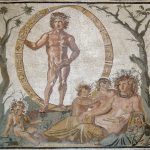
Figure 1. The antique mosaic shows a central part of a large floor mosaic, from a Roman villa in Sentinum (now Sassoferrato, in Marche, Italy), ca. 200–250 C.E. The Hellenistic deity named Aion (Greek: Αἰών), the god of time and eternity, is standing inside a celestial sphere (presumably the orb circle encompassing the universe) decorated with zodiac signs, in between a green tree and a bare tree (symbolizing summer and winter, respectively). Sitting in front of him is the mother-earth goddess, Tellus (the Roman counterpart of Gaia) with her four children, who possibly represent the four seasons. Conceptions of “time” play an essential rôle in ancient philosophical schools of thought and consequently in Greek mythology and modern science (subjects which are deeply interwoven).
You can use the mouse-wheel to zoom within the application.
Plain numerical DOI: 10.1038/nchem.172
DOI URL
directSciHub download
Show/hide publication abstract
“Aromaticity is a key concept in chemistry, dating back to faraday’s discovery of benzene in 1825 and kekulé’s famous alternating-double-bond structure of 1865. in 1858, the möbius strip was discovered by möbius and listing. the hückel rules for predicting aromaticity, stating that [4n + 2] π electrons result in an aromatic system, work for planar molecules. although molecules with möbius geometry are not found in nature, chemists have tried to synthesize such molecules since the first theoretical prediction by heilbronner in 1964 and the prediction of möbius aromaticity for suitable compounds with [4n] π electrons. however, möbius-aromatic molecules have proved difficult to synthesize, and sometimes even to identify. here we summarize recent contributions of several research groups that have succeeded in synthesizing möbius-type molecules. the results of this survey lead us to suggest that the generation of möbius topologies in expanded porphyrins is easier than hitherto appreciated.”
Plain numerical DOI: 10.1038/nature02224
DOI URL
directSciHub download
Show/hide publication abstract
“The defining feature of aromatic hydrocarbon compounds is a cyclic molecular structure stabilized by the delocalization of pi electrons that, according to the hückel rule, need to total 4n + 2 (n = 1,2, em leader ); cyclic compounds with 4n pi electrons are antiaromatic and unstable. but in 1964, heilbronner predicted on purely theoretical grounds that cyclic molecules with the topology of a möbius band-a ring constructed by joining the ends of a rectangular strip after having given one end half a twist-should be aromatic if they contain 4n, rather than 4n + 2, pi electrons. the prediction stimulated attempts to synthesize möbius aromatic hydrocarbons, but twisted cyclic molecules are destabilized by large ring strains, with the twist also suppressing overlap of the p orbitals involved in electron delocalization and stabilization. in larger cyclic molecules, ring strain is less pronounced but the structures are very flexible and flip back to the less-strained hückel topology. although transition-state species, an unstable intermediate and a non-conjugated cyclic molecule, all with a möbius topology, have been documented, a stable aromatic möbius system has not yet been realized. here we report that combining a ‘normal’ aromatic structure (with p orbitals orthogonal to the ring plane) and a ‘belt-like’ aromatic structure (with p orbitals within the ring plane) yields a möbius compound stabilized by its extended pi system.”
Plain numerical DOI: 10.1103/PhysRevLett.105.235501
DOI URL
directSciHub download
Show/hide publication abstract
“We experimentally observed a new topological symmetry in optical composites, namely, metamaterials. while it is not found yet in nature materials, the electromagnetic möbius symmetry discovered in metamaterials is equivalent to the structural symmetry of a möbius strip, with the number of twists controlled by the sign change of the electromagnetic coupling between the meta-atoms. we further demonstrate that metamaterials with different coupling signs exhibit resonance frequencies that depend only on the number but not the locations of the ‘twists,’ thus confirming its topological nature. the new topological symmetry found in metamaterials may enable unique functionalities in optical materials.”
Plain numerical DOI: 10.1038/s41467-018-05498-6
DOI URL
directSciHub download
Show/hide publication abstract
“Besides its mathematical importance, the möbius topology (twisted, single-sided strip) is intriguing at the molecular level, as it features structural elegance and distinct properties; however, it carries synthetic challenges. although some möbius-type molecules have been isolated by synthetic chemists accompanied by extensive computational studies, the design, preparation, and characterization of stable möbius-conjugated molecules remain a nontrivial task to date, let alone that of molecular möbius strips assembling into more complex topologies. here we report the efficient synthesis, crystal structure, and theoretical study of a catenane consisting of two fully conjugated nanohoops exhibiting möbius topology in the solid state. this work highlights that oligoparaphenylene-derived nanohoops, a family of highly warped and synthetically challenging conjugated macrocycles, can not only serve as building blocks for interlocked supermolecular structures, but also represent a new class of compounds with isolable möbius conformations stabilized by non-covalent interactions.”
Plain numerical DOI: 10.1002/asi.20336
DOI URL
directSciHub download
Show/hide publication abstract
“The open video digital library (ovdl) provides digital video files to the education and research community and is distinguished by an innovative user interface that offers multiple kinds of visual surrogates to people searching for video content. the ovdl is used by several thousand people around the world each month and part of this success is due to its user interface. this article examines the interplay between research and practice in the development of this particular digital library with an eye toward lessons for all digital libraries. we argue that theoretical and research goals blur into practical goals and practical goals raise new research questions as research and development progress—this process is akin to walking along a möbius strip in which a locally two-sided surface is actually part of a globally one-sided world. we consider the gulf between the theories that guide current digital library research and current practice in operational digital libraries, provide a developmental history of the ovdl and the research frameworks that drove its development, illustrate how user studies informed its implementation and revision, and conclude with reflections and recommendations on the interplay between research and practice.”
Plain numerical DOI: 10.1073/pnas.1015997107
DOI URL
directSciHub download
Show/hide publication abstract
“It is well-known that a soap film spanning a looped wire can have the topology of a möbius strip and that deformations of the wire can induce a transformation to a two-sided film, but the process by which this transformation is achieved has remained unknown. experimental studies presented here show that this process consists of a collapse of the film toward the boundary that produces a previously unrecognized finite-time twist singularity that changes the linking number of the film’s plateau border and the centerline of the wire. we conjecture that it is a general feature of this type of transition that the singularity always occurs at the surface boundary. the change in linking number is shown to be a consequence of a viscous reconnection of the plateau border at the moment of the singularity. high-speed imaging of the collapse dynamics of the film’s throat, similar to that of the central opening of a catenoid, reveals a crossover between two power laws. far from the singularity, it is suggested that the collapse is controlled by dissipation within the fluid film surrounding the wire, whereas closer to the transition the power law has the classical form arising from a balance between air inertia and surface tension. analytical and numerical studies of minimal surfaces and ruled surfaces are used to gain insight into the energetics underlying the transition and the twisted geometry in the neighborhood of the singularity. a number of challenging mathematical questions arising from these observations are posed.”
Plain numerical DOI: 10.1021/ja00375a051
DOI URL
directSciHub download
Plain numerical DOI: 10.1002/anie.200460211
DOI URL
directSciHub download
Show/hide publication abstract
“Understanding frustration: the control of structure through the choice of the template has allowed the synthesis of nonanuclear metal wheels that contain {cr8ni} or {cr7(vo)2} cores. magnetic studies (see picture) of one of these wheels shows that it behaves as a magnetic möbius strip. these are the first detailed magnetic studies of an odd-numbered ring larger than trinuclear and should help in the understanding of spin-frustrated systems.”
Plain numerical DOI: 10.1109/22.898999
DOI URL
directSciHub download
Show/hide publication abstract
“It is shown that a topological surface known as the mobius strip has applications to electromagnetic resonators and filters. using identical rectangles to construct a cylindrical loop and a mobius strip results in the path length of the edge of the mobius strip being twice the path length of an edge of the cylindrical loop. this path-length advantage is consistent with the electromagnetic analog of a mobius strip resonating at half the resonant frequency of the electromagnetic analog of the cylindrical loop even though b) they have the same mean diameter. dual-mode mobius resonators have been demonstrated in planar format and as wire-loaded cavities. two-pole bandpass filters have been constructed using these resonators. it is shown that these bandpass filters possess intrinsic transmission zeros that can be adjusted to enhance filter response. an equivalent circuit, which demonstrates excellent agreement with measured data, is presented and discussed”
Plain numerical DOI: 10.1016/j.jfluidstructs.2009.04.007
DOI URL
directSciHub download
Show/hide publication abstract
“A möbius band is a three-dimensional surface with the particular feature of having only one side and one edge. a simple geometrical model consists of a circular centreline, and surface elements which are locally tangent to this line and continuously twist around it, completing one-half turn going once around the circle. from an aerodynamic perspective, such a möbius strip presents a profile that is locally a flat plate with an angle of attack smoothly varying between – 90{ring operator}and 90{ring operator}, and this regardless of the orientation of the object. we here present results from an experimental study of möbius bands in free fall, focussing on the trajectory, body motion and wake dynamics. free-fall experiments were carried out at low reynolds numbers in a water tank, with möbius bands made of different plastic materials, having an aspect ratio (perimeter/width) of 14. the bands are found to rapidly adopt a bluff leading edge orientation and to follow a spiral path, with an independent frequency of pitching. © 2009 elsevier ltd. all rights reserved.”
Show/hide publication abstract
“Protein beta-strands can form beta-barrels and other complicated structures. this paper defines bifurcations and pseudobifurcations of beta-sheets. they are important structural elements for protein folding. this paper also presents a characteristic number that can be used to test whether the surface of a closed beta-sheet is one- or two-sided. searching the whole protein data bank released in april 1997 with the definition of beta-structures given by the dssp program, we do not find any one-sided beta-möbius band. however, there are interesting structures such as beta-bands with odd number of antiparallel ladders and odd number of bifurcations. there are also beta-structures that are closed only at a singular point. adding a small patch near the singular point in different ways can make it a one- or two-sided surface. the catalytic triad of a gmp synthetase (1gpm) is near the singular point of such a beta-sheet.”
Plain numerical DOI: 10.1007/s00283-016-9631-8
DOI URL
directSciHub download
Show/hide publication abstract
“August m”obius discovered his eponymous strip — also found almost contemporaneously by johann listing — in 1858, so a pre-1858 m”obius band would be an interesting object. it turns out there were lots of them.”
Plain numerical DOI: 10.1007/s10659-014-9489-y
DOI URL
directSciHub download
Show/hide publication abstract
“The following is a translation of walter wunderlich’s article ‘über ein abwickelbares möbiusband’, which appeared in the monatshefte für mathematik66 (1962), 276-289 and was dedicated to prof. dr. paul funk on the occasion of his 75th birthday. wunderlich summarizes sadowsky’s work (sitzber. preuss. akad. wiss. 22:412-415, 1930 ; verhandlungen des 3. internationalen kongresses für technische mechanik, ii (stockholm, 1930), pp. 444-451, sveriges litografiska tryckerier, stockholm, 1931) on developable möbius bands and improves sadowsky’s upper bound of the dimensionally-reduced variational description for determining the configuration of a möbius band whose width is small in comparison to its length. attempting to reproduce the equilibrium depiction of a band of finite width, using a rational-algebraic developable, wunderlich then extends sadowsky’s results by presenting perhaps the first successful model of a closed, analytic, developable möbius band with associated thinness bounds. this translation makes wunderlich’s work accessible to the broader research community at a time of growing interest in and relevance of thin-walled structural elements. © 2014 springer science+business media dordrecht.”

This work is licensed under a Creative Commons Attribution-NonCommercial-ShareAlike 4.0 International License.
(CC) 2016—2019 | #Sitemap | #Sitemap | §Dataprotection according to GDPR |
 This project was funded by the EU Marie Curie Initial Training Network FP7-PEOPLE-2013-ITN-604764

→ Primary goals of research and innovation policy as defined by the European Comission: Open Innovation, Open Science, Open to the World.
Legal disclaimer: The interdisciplinary Marie Curie CogNovo program has been intentionally designed by the European Union and the University of Plymouth (United Kingdom) to discuss and disseminate a wide view on a diverse spectrum of topics including psychology, neuroscience, current affairs, basic science, humanities, and the arts, inter alia. Note that the views and opinions expressed on this website do not necessarily represent the opinions of any of the institutions mentioned on this website and belong exclusively to author. The CogNovo program explicitly emphasises cognitive and social innovation, the generation of new ideas and perspectives, and the probing of boundaries, but see https://www.cognovo.eu/about/
